

Home
Class 11
PHYSICS
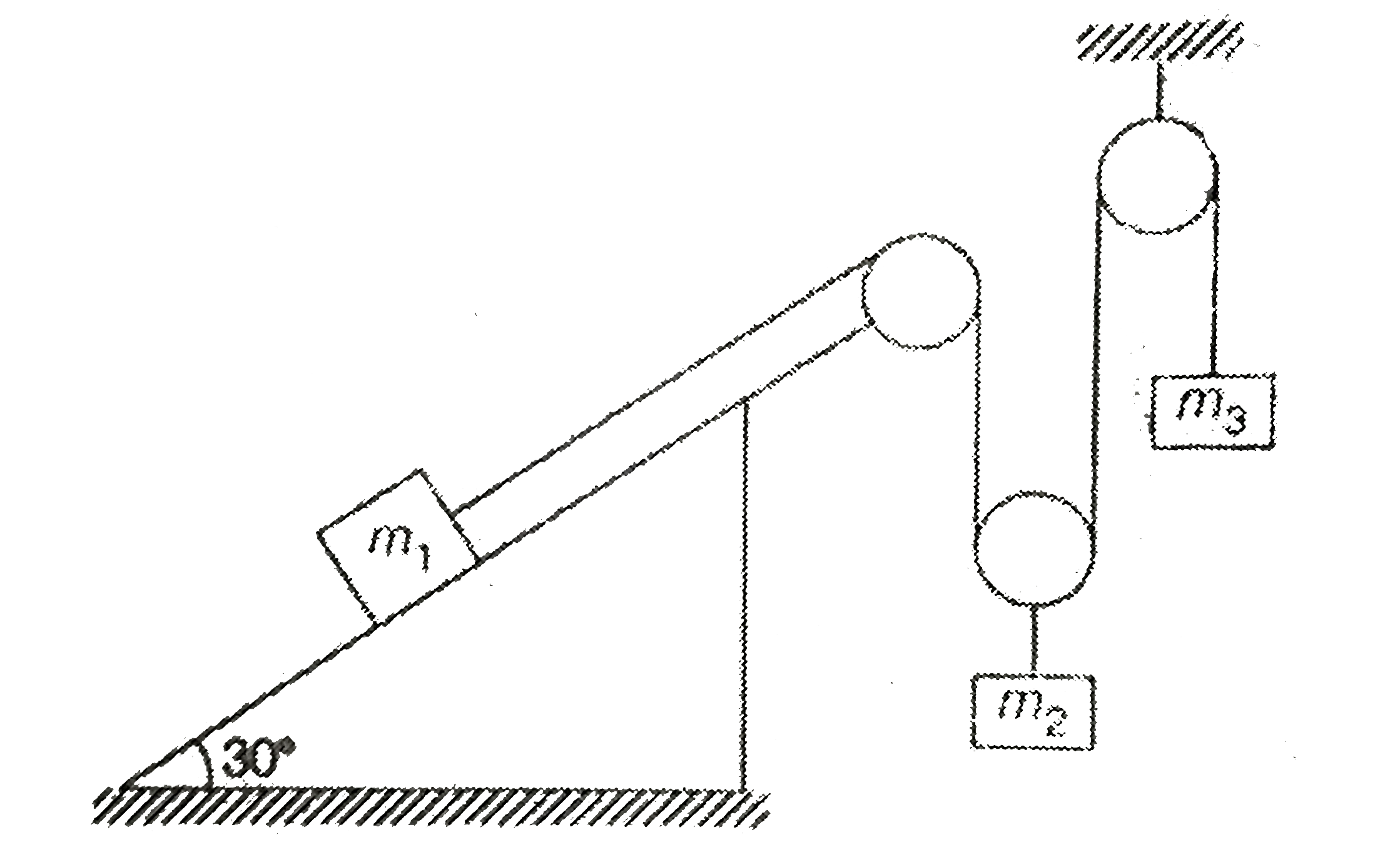
All surfaces shown in figure are smooth....

All surfaces shown in figure are smooth. For what ratio `m_(1): m_(2):m_(2):m_(3)`, system is in equilibrium. All pulleys and strings are massless.

Promotional Banner

Similar Questions

Explore conceptually related problems

Find m_(3) if the system is in equilibrium the incline is smooth and string and pulley are light

Find m_(3) if the system is in equilibrium the incline is smooth and string and pulley are light

In the situation shown in figure F=500 newton applied on the pulley m_(1)=50 kg and m_(2) = 10 kg and pulley and strings are massless and frictionless. Then the acceleration of the pulley is : [g = 10 m//s^(2)]

A step pulley system is shown in figure-2.50. Find the relation in masses m and M for which the system remain in equilibrium. Assume string will not slide over the pulleys. ((r_(1))/(r_(2))=(1)/(2),(r_(3))/(r_(4))=(3)/(4)) [(M)/(m)=(3)/(8)sintheta]

In the system shown in the figure, all surfaces are smooth. Block A and B have mass m each and mass of block C is 2 m. All pulleys are massless and fixed to block C. Strings are light and the force F applied at the free end of the string is horizontal. Find the acceleration of all three blocks.

In figure shown, pulleys are ideal m_(1)gt 2m_(2) . Initially the system is in equilibrium and string connecting m_(2) to rigid support below is cut. Find the initial acceleration of m_(2) ?

Figure shows an arrangement of pulleys and two blocks. All surfaces are frictionless . All pulleys and strings are massless. All string are smooth and massless. The acceleration of block A is :

Figure shows an arrangement of pulleys and two blocks. All surfaces are frictionless . All pulleys and strings are massless. All string are smooth and massless. The acceleration of block A is :

A situation is shown in figure-2.15, Find the acceleration of masses m_(1) abd m_(2) mass of pulley is m_(P) . Consider the string going over the pulley is massless and frictionless.