

Home
Class 12
PHYSICS
If you carry out the integral of the ele...

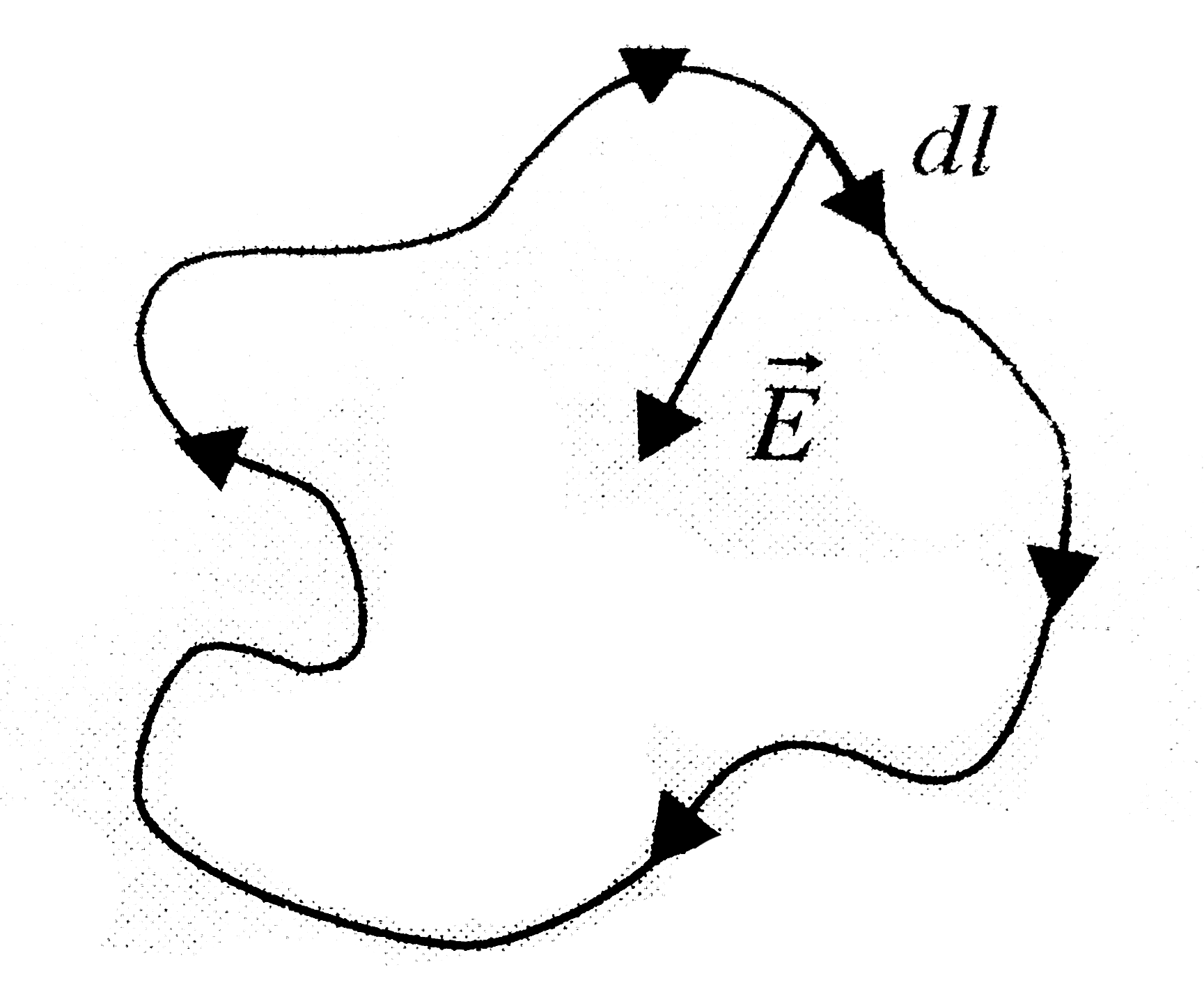
If you carry out the integral of the electric field `int vec E. vec d l` for a closed path like that as shown in (Fig. 3.40), the integral will always be equal tom zero, independent of the shape of the path and independent of where charges may be located relative to the path. Explain why.
.

Promotional Banner

Similar Questions

Explore conceptually related problems

In electrostatics both the electric field intensity (E) and potential (V) are closely related. Show that the line integral of electric field along any closed path is zero.

A uniform electric field E exists between two charged plates as shown in Fig.HQ 2. What would be the work donw in moving a charge q along the closed rectangular path ABCDA?

The line integral of magnetic field vec(B) around any closed path through which current I is flowing is given by oint_(c) vec(B).vec(d) l =

The line integral of magnetic field vec(B) around any closed path through which current I is flowing is given by oint_(c) vec(B).vec(d) l =

A uniform electric field E axis between two charged plates as shown in Fig. What would be work done in moving a charge q along the closed recetangualr path ABCDA ?

Statement I: no electric current will be present within a region having uniform and constant magetic field. Statement II: Within a region of unifrom and cinstant magnetic field vec(B) , the path integral of magnetic field oint vec(B).dvec(l) along any closed path is zero. Hence, from Ampere cirauital law oint vec(B).dvec(l) = mu_(0)I (where the given terms ahve usual meaning), no current can be present within a region having uniform and constant magnetic field .

Statement I: no electric current will be present within a region having uniform and constant magetic field. Statement II: Within a region of unifrom and cinstant magnetic field vec(B) , the path integral of magnetic field oint vec(B).dvec(l) along any closed path is zero. Hence, from Ampere cirauital law oint vec(B).dvec(l) = mu_(0)I (where the given terms ahve usual meaning), no current can be present within a region having uniform and constant magnetic field .

A velocity filter uses the properties of electric and magnetic field to select particles that are moving with a specifice velocity. Charged particles with varying speeds are directed into the filter as shown. The filter consistt of an electric field E and a magnetic field B, each of constant magnitude, directed perpendicular to each other as shown, The charge particles will experience a force due to electric field given by F = qE. If positively charged particles are used, this force is towards right. The moving particle will also experience a force due to magnetic field given by F = qvB. When forces due to the two fields are of equal magnitude, the net force on the particle will be zero, the particle will pass through centre with its path unaltered. The electric and magnetic fields can be adjusted t choose the specific velocity to be filtered. The efect of gravity can be neglected. Which of the following is true about the velocity filter shown in Fig,

A velocity filter uses the properties of electric and magnetic field to select particles that are moving with a specifice velocity. Charged particles with varying speeds are directed into the filter as shown. The filter consistt of an electric field E and a magnetic field B, each of constant magnitude, directed perpendicular to each other as shown, The charge particles will experience a force due to electric field given by F = qE. If positively charged particles are used, this force is towards right. The moving particle will also experience a force due to magnetic field given by F = qvB . When forces due to the two fields are of equal magnitude, the net force on the particle will be zero, the particle will pass through centre with its path unaltered. The electric and magnetic fields can be adjusted t choose the specific velocity to be filtered. The efect of gravity can be neglected. The electric and magnetic fields are adjusted to detect particles with positive charge q of certain speed v_(0) . which of the following expressions is equal to this speed?