Home
Class 7
MATHS
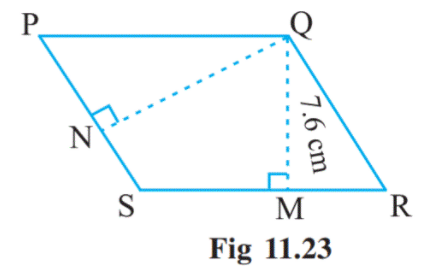
PQRS is a parallelogram (Fig 11.23). QM ...

`PQRS` is a parallelogram `(Fig 11.23). QM` is the height from `Q` to `SR and QN` is the height from `Q` to `PS.` If `SR=12cm and QM=8cm`.
Find : `"(a) the area of the parallegram"` `PQRS`
(b) `QN,` if `PS=8cm`

Text Solution

Verified by Experts

It is given that
Height and QM = `7*6 cm`
SR as base = `12cm`
We know that,
Area of parallelogram = `Base × Height`
SR×QM*
...
Promotional Banner

Topper's Solved these Questions

  • PERIMETER AND AREA

    NCERT|Exercise SOLVED EXAMPLES|22 Videos
  • LINES AND ANGLES

    NCERT|Exercise SOLVED EXAMPLES|1 Videos
  • RATIONAL NUMBERS

    NCERT|Exercise SOLVED EXAMPLES|6 Videos

Similar Questions

Explore conceptually related problems

PQRS is a parallelogram,QM is the height from Q to SR and QN is the height from Q to PS.IF SR=12cm and QM=7.6cm

PQRS is a parallelogram in which PR is perpendicular to QS. If PR=8cm and QS=6 cm, then find PS

In Delta PQR, PR = 8cm, QR = 4 cm and PL = 5 cm (Fig 11.22). Find: (i) the area of the Delta PQR (ii) QM

One of the sides and the corresponding height of a parallelogram are 4cm and 3cm respectively.Find the area of the parallelogram (Fig 11.17).

Two adjacent sides PS and RS of the parallelogram PQRS are 6 cm and 12 cm respectively. The height corresponding to the base RS is 5 cm. Find (i) the area of the parallelogram PQRS and (ii) the height corresponding to base PS.

PQRS is a parallelogram.PX and QY are respectively,the perpendiculars from P and Q to SR and RS produced.Frove that PX=QY.

PQRS is an isosceles trapezium in which PS = 10 cm, PQ = SR = 13 cm and the distance between PS and QR is 12 cm. Find the area of the trapezium.

PQRS is a parallelogram.PS is produced to M, so that SM=SR and MR produced meets PQ produced at N. Prove that QN=QR
