

Home
Class 11
PHYSICS
There are two cars on a straight road, m...

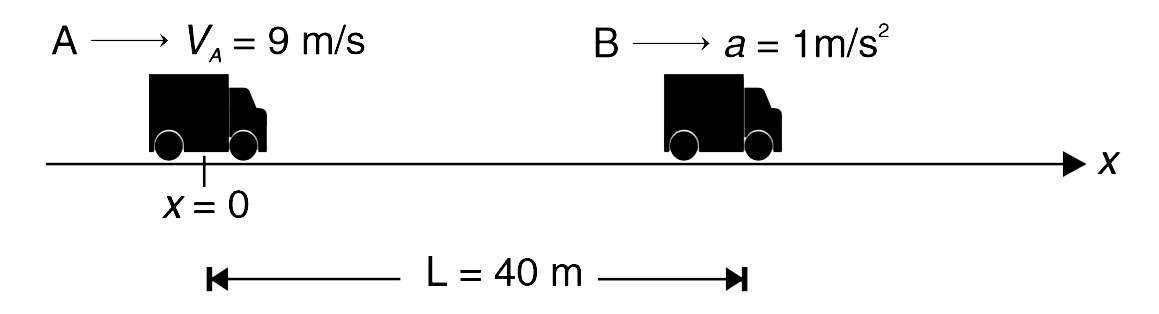
There are two cars on a straight road, marked as x axis. Car A is travelling at a constant speed of `V_(A) = 9 m//s`. Let the position of the Car A, at time `t = 0`, be the origin. Another car B is `L = 40 m` ahead of car A at `t = 0` and starts moving at a constant acceleration of `a = 1 m//s^(2)` (at t = 0). Consider the length of the two cars to be negligible and treat them as point objects.

(a) Plot the position–time `(x–t)` graph for the two cars on the same graph. The two graphs intersect at two points. Draw conclusion from this.
(b) Determine the maximum lead that car A can have.

Promotional Banner

Similar Questions

Explore conceptually related problems

Two cars A and B are at rest at the origin O. If A starts with a uniform velocity of 20 m// s and B starts in the same direction with a constant acceleration of 2 m//s^(2) , then the cars will meet after time

A truck travelling along a straight road at a constant speed of 72 kph passes a car at time t = 0 moving much slower. At the instant the truck passes the car, the car starts accelerating at constant 1m//s^(2) and overtake the truck 0.6 km further down the road, from where the car moves uniformly. Find the distance between them at time t = 50 s .

Initially car A is 10.5 m ahead of car B . Both start moving at time t = 0 in the same direction along a straight line. The velocity-time graph of two cars is shown in figure. The time when the car B will catch the car A , will be.

Initially car A is 10.5 m ahead of car B . Both start moving at time t = 0 in the same direction along a straight line. The velocity-time graph of two cars is shown in figure. The time when the car B will catch the car A , will be.

Initially car A is 10.5 m ahead of car B . Both start moving at time t = 0 in the same direction along a straight line. The velocity-time graph of two cars is shown in figure. The time when the car B will catch the car A , will be.

A car moving the constant acceleration cross two points A and B with velocities 10m/s and 20m/s in its path.Find the velocity of the car midway between A and B . (in m/s)

At t=0 and x=0 , an initially stationary blue car begins to accelerate at a constant rate of 2.0m//s^(2) in the positive direction of the x -axis At =t = 2s a red car travelling in an adjecent lane and in the same direction passes x =0 with a speed of 8.0 m//s and a constant accleration of 3.0 m//s^(2) .the time when red car passes the blue car is :

At t=0 and x=0 , an initially stationary blue car begins to accelerate at a constant rate of 2.0m//s^(2) in the positive direction of the x -axis At =t = 2s a red car travelling in an adjecent lane and in the same direction passes x =0 with a speed of 8.0 m//s and a constant accleration of 3.0 m//s^(2) .the time when red car passes the blue car is :

Car A starts from a point O and moves with constant velocity 9 m//s . After 2 s , another car B begins its journey from O and follows car A . If car B starts from rest and moves under constant acceleration 4 m//s^(2) , after how much time and at what distance from O the cars meet?

A car travelling along a road begins accelerating with a constant acceleration of 1.5 m//s^(2) in the direction of motion. After travelling 392 m at this acceleration, its speed is 35 m/s. Determine the speed of the car when it began accelerating.