

Home
Class 12
PHYSICS
Two liquids which do not react chemicall...


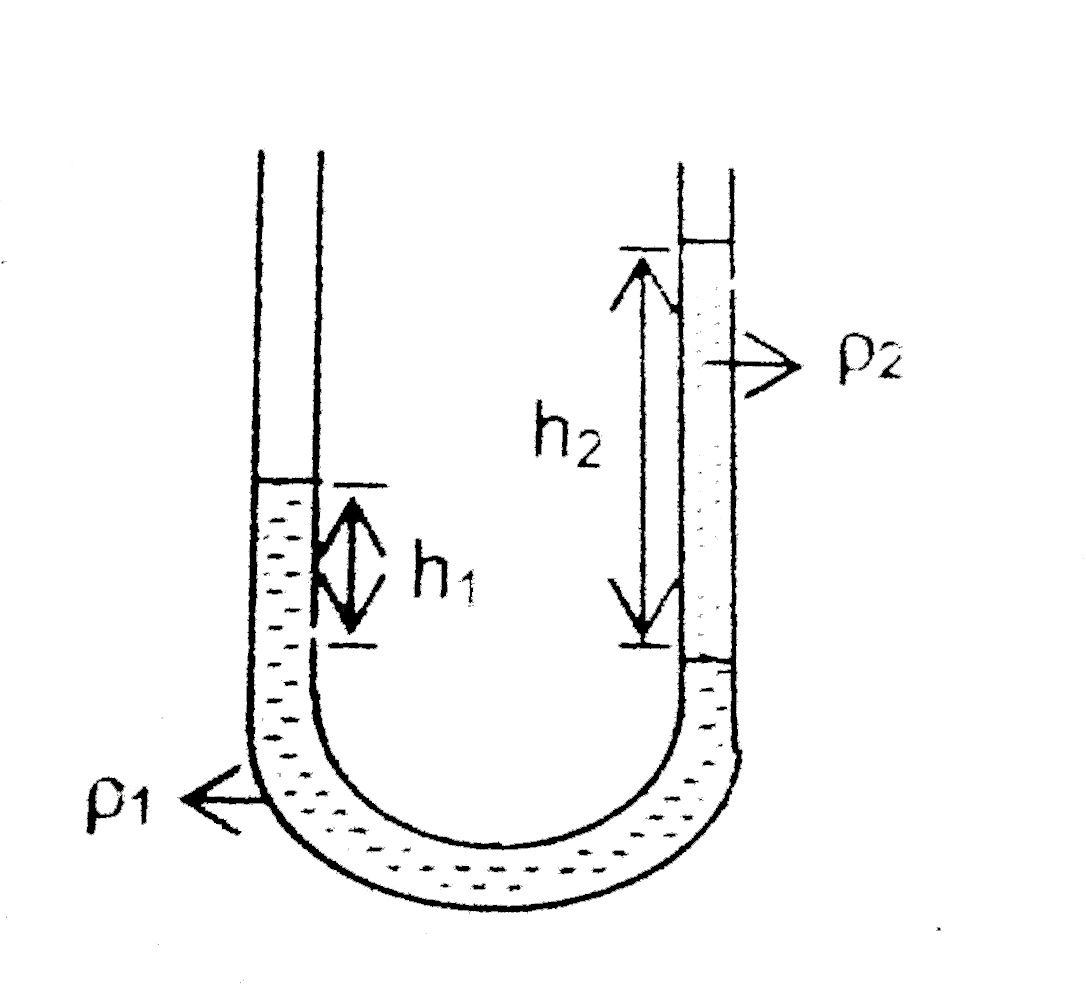
Two liquids which do not react chemically are placed in a bent tube as shown in figure. The height of the liquids above their surface of separation are

Promotional Banner

Similar Questions

Explore conceptually related problems

Two chemically non-reactive liquids are placed in a U-shaped tube as shown in the figure. The height of any liquid above a common reference line is

Two chemically non-reactive liquids are placed in a U-shaped tube as shown in the figure. The height of any liquid above a common reference line is

If two immiscible liquids in a U-tube are in equilibrium, then how are the heights of the two liquids from the surface of separation related with the densities of the two liquids?

Two liquid A & B having densities 2rho and rho respectively, are kept in a cylindrical container separated by a partition as shown in figure. The height of each liquid in the container is h and area of cross section of the container is A. Now the partition is removed. Calculate change in gravitational potential energy ( DeltaU ) of the system (a) assuming that the two liquids mix uniformly. (b) Assuming that the two liquids are immiscible. What do you conclude from the sign of DeltaU in the above two cases?

A liquid of density rho is filled in a U-tube is accelerated with an acceleration a so that the height of liquid in its two vertical arms are h_1 and h_2 as shown in the figure. If l is the length of horizontal arm of the tube, the acceleration a is

A liquid of density rho is filled in a U-tube is accelerated with an acceleration a so that the height of liquid in its two vertical arms are h_1 and h_2 as shown in the figure. If l is the length of horizontal arm of the tube, the acceleration a is

A man observes a coin placed at the bottom of a beaker which contains two immiscible liquids of refractive indices 1.2 and 1.4 as shown in the figure. Find the depth of the coin below the surface, as observed from above.

An incompressible liquid flows through a horizontal tube LMN as shown in the figure. Then the velocity V of the liquid throught he tube N is: