

Home
Class 12
PHYSICS
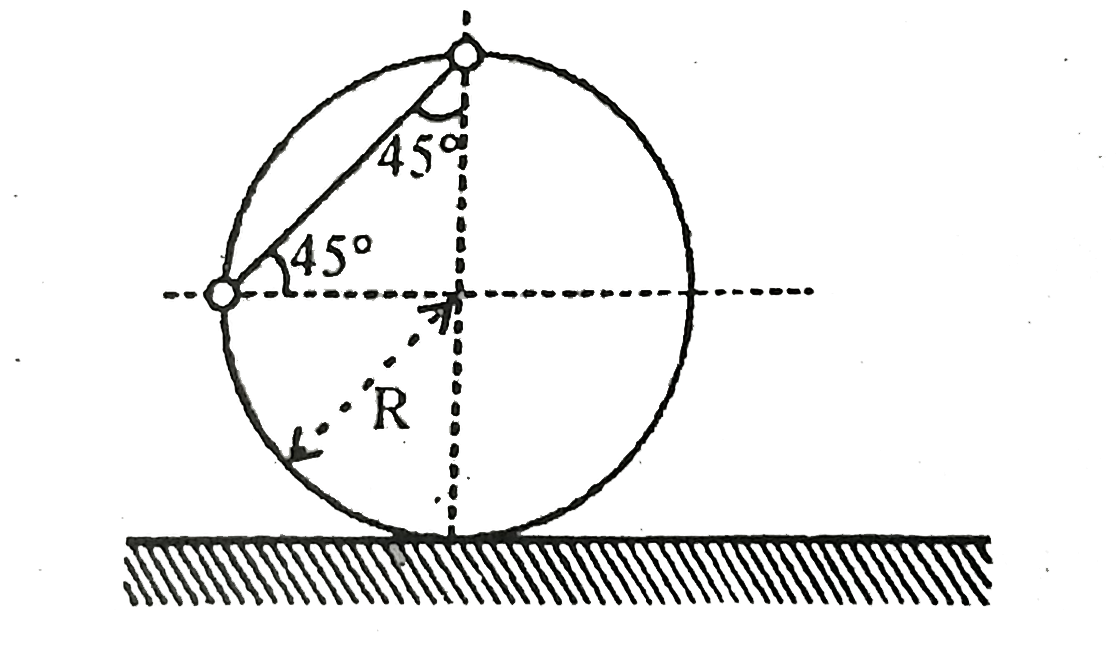
Two beads connected by a light inextensi...

Two beads connected by a light inextensible string are placed over fixed vertical rings as shown in figure If mass of each bead is 100 gms and all surfaces are frictionless if the tension (T) in the string just after the beads are released from the shown position, then find `100T^(2) (in N^(2))`

Promotional Banner

Similar Questions

Explore conceptually related problems

Consider the system as shown in the figure. The pulley and the string are light and all the surfaces are frictionless. The tension in the string is (=g10m//s^(2)) .

Two beads A & B of equal mass m are connected by a light inextensible to move on a connected to move on a frictionless ring in vertical plane. The beads are released from rest as shown. The tension in the cord just after the release is:

Two masses 2 kg and 4 kg are connected at two ends of light inextensible string passing over a frictionless pulley . If the masses are released , then find the accelaration of the masses and the tension in the string .

Two masses 2 kg and 4 kg are connected at two ends of light inextensible string passing over a frictionless pulley . If the masses are released , then find the accelaration of the masses and the tension in the string .

Figure shows two blocks connected by a light inextensible string as shown in figure. A force of 10 N is applied on the bigger block at 60^(@) with horizontal, then the tension in the st ring connection the two masses is -

Figure shows two blocks connected by a light inextensible string as shown in figure. A force of 10 N is applied on the bigger block at 60^(@) with horizontal, then the tension in the st ring connection the two masses is -

Two masses 2 kg and 4 kg are connected at the two ends of light inextensible string passing over a frictionless pulley. If the masses are released, then find the acceleration of the masses and the tension in the string.

Two masses 2 kg and 4 kg are connected at the two ends of light inextensible string passing over a frictionless pulley. If the masses are released, then find the acceleration of the masses and the tension in the string.

Calculate the tension in the string shown in figure. The pulley and the string are light and all surfaces are frictionless. Take g=10 m/ s^2 .