

Home
Class 11
PHYSICS
From what minimum height hmust the syste...

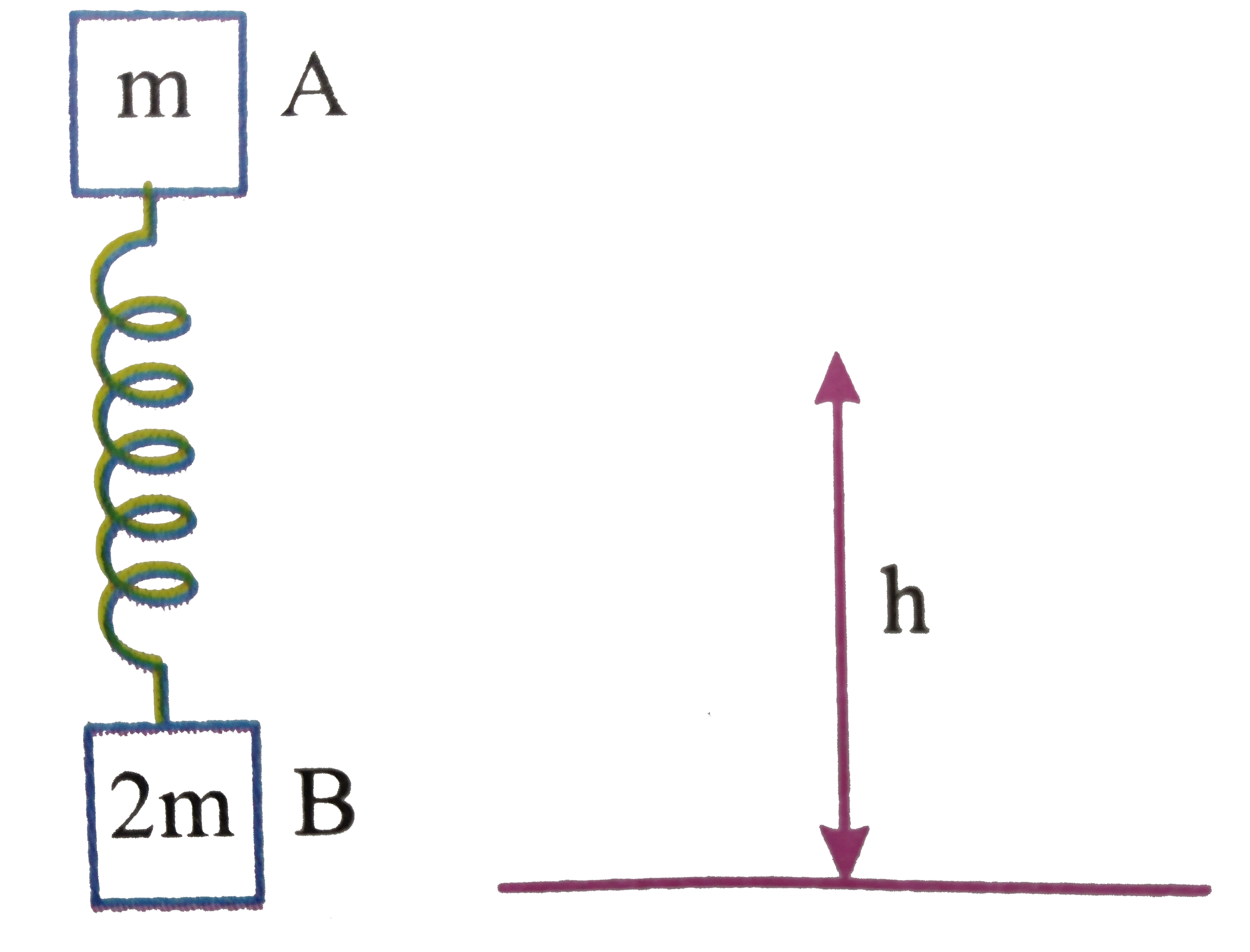
From what minimum height `h`must the system be released when spring is unstretches so that after perfectly inelastic collision `(e =0)` with ground, `B` may be lifted off the gound: (Spring constant `=k)`

Promotional Banner

Similar Questions

Explore conceptually related problems

A tennis ball is released from height h above ground level. If the ball makes inelastic collision with the ground, to what height will it rise after third collision

A block A of mass m is give a velocity v_(0) towards another block B of sae mass B . Is attached to an ideal spring of spring constant K . A makes a head on perfectly inelastic collision with B . Answer the following two questions: Q. Choose the correct option (s)

A block A of mass m is give a velocity v_(0) towards another block B of sae mass B . Is attached to an ideal spring of spring constant K . A makes a head on perfectly inelastic collision with B . Answer the following two questions: Q. Let the collision takes place at time t=0 choose the instant (s), when the spring is in its natural length.

A block A of mass m is give a velocity v_(0) towards another block B of sae mass B . Is attached to an ideal spring of spring constant K . A makes a head on perfectly inelastic collision with B . Answer the following two questions: Q. Let the collision takes place at time t=0 choose the instant (s), when the spring is in its natural length.

Blocks A and B shown in the figure are having equal masses m. The system is released from rest with the spring unstretched. The string between A and ground is cut, when there is maximum extension in the spring. The acceleration of centre of mass of the two blocks at this instant is

Blocks A and B shown in the figure are having equal masses m. The system is released from rest with the spring unstretched. The string between A and ground is cut, when there is maximum extension in the spring. The acceleration of centre of mass of the two blocks at this instant is

There are two identical particles A and B. One is projected vertically upward with speed sqrt(2gh) from ground and other is dropped from height h along the same vertical line. Collision between them is perfectly inelastic. Find time taken by them to reach the ground after collision in terms of sqrt(h/g) .

There are two identical particles A and B. One is projected vertically upward with speed sqrt(2gh) from ground and other is dropped from height h along the same vertical line. Collision between them is perfectly inelastic. Find time taken by them to reach the ground after collision in terms of sqrt(h/g) .