

Home
Class 12
PHYSICS
For the system shown in fig., initially ...

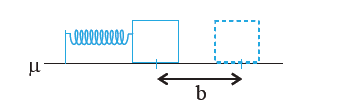
For the system shown in fig., initially the spring is compressed by a distance 'a' from its natural length and when released, it moves to a distance 'b' from its equillibrium position, the decrease in amplitude for half cycle (-a to +b) is :

Promotional Banner

Similar Questions

Explore conceptually related problems

A mass-spring system oscillates such that the mass moves on a rough surface having coefficient of friction mu . It is compressed by a distance a from its normal length and, on being released, it moves to a distance b from its equilibrium position. The decrease in amplitude for one half-cycle (-a to b) is

A mass-spring system oscillates such that the mass moves on a rough surface having coefficient of friction mu . It is compressed by a distance a from its normal length and, on being released, it moves to a distance b from its equilibrium position. The decrease in anplitude for one half-cycle (-a to b) is

The system shown in the figure can move on a smooth surface. The spring is initially compressed by 6 cm and then released.

The system shown in the figure can move on a smooth surface. The spring is initially compressed by 6 cm and then released.

A spring of force constant K is first stretched by distance a from its natural length and then further by distance b. The work done in stretching the part b is

Find the time period of mass M when displaced from its equilibrium position and then released for the system shown in figure.

Find the time period of mass M when displaced from its equilibrium position and then released for the system shown in figure.

Find the time period of mass M when displaced from its equilibrium position and then released for the system shown in figure.

The spring is compressed by a distance a and released. The block again comes to rest when the spring is elongated by a distance b . During this