

Home
Class 11
PHYSICS
A thin plate of mass M,length L and widt...

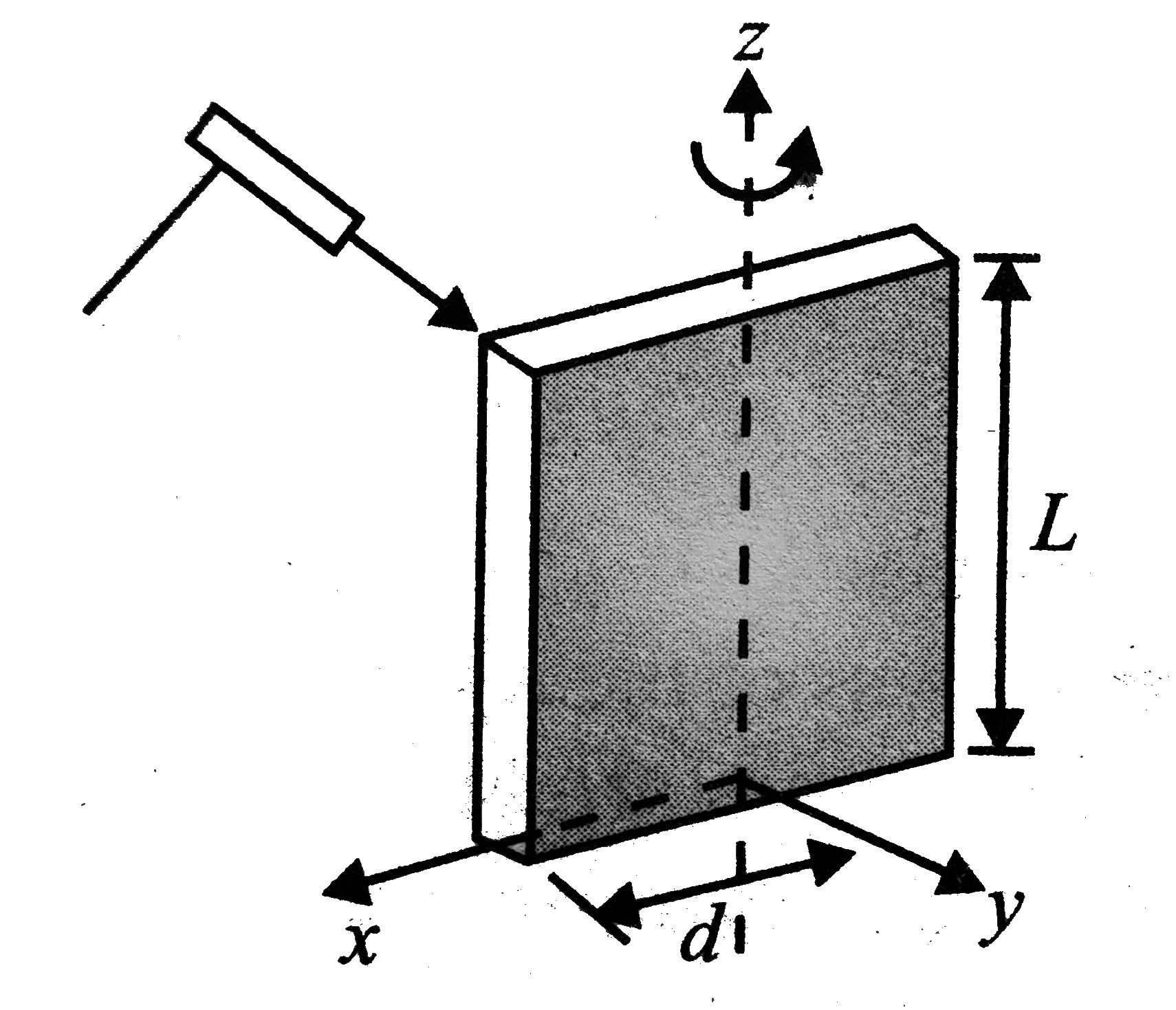
A thin plate of mass `M`,length `L` and width `2d` is mounted vertically on a frictionless fixed axle along the `z`-axis as shown. Initially, the object is at rest. it is then tapped with a hammer to provide a torque `tau`, which produces an angular impulse `H` about the z-axis of magnitude `H = int tau dt`. What is the angular speed co of the plate about the `z`-axis after the tap?

Promotional Banner

Similar Questions

Explore conceptually related problems

A cylinder having moment of inertia, which is free to rotate about its axis, receives an angular impulse of J kgm^(2)//s initially, followed by similar impulse after every 4 s . What is the angular speed of the cylinder 30 s after the initial impulse?

A cylinder having moment of inertia, which is free to rotate about its axis, receives an angular impulse of J kgm^(2)//s initially, followed by similar impulse after every 4 s . What is the angular speed of the cylinder 30 s after the initial impulse?

If L is the angular momentum and tau is the torque then prove that ( tau = dL/dt)

A solid cylinder of mass 10 kg and radius 20 cm is free to rotate about its axis. It receives an angular impulse of 4 kgm^(2)rad//s . What is the angular speed of the cylinder if the cylinder is initially at rest ?

A solid sphere (initially at rest) of mass 7 kg and radius 40 cm which is free to rotate about its axis is given an angular impulse of 5kgm^(2)s^(-1) followed by the similar impulse after every 5 second. Calculate the angular speed of sphere 50 s after the initial impulse.

What is the moment of inertia of the thin uniform rectangular plate of mass m about the diagonal axis xx' ?

A wheel of mass 2 kg and radius 20 cm initially at rest is free to rotate about its axis. It receives an angular impulse of 4kgm^(2)s^(-1) initially and similar impulse after every 5 s of initial one. Calculate the angular speed of the wheel 22 s after the initial impulse.

A particle of mass m is released in vertical plane from a point P at x=x_(0) on the x -axis. It falls vertically parallel to the y -axis. Find the torque tau acting on the particle at a time about origin.