

Home
Class 11
PHYSICS
Given m(A) = 30 kg, m(B) = 10 kg, m(C) =...

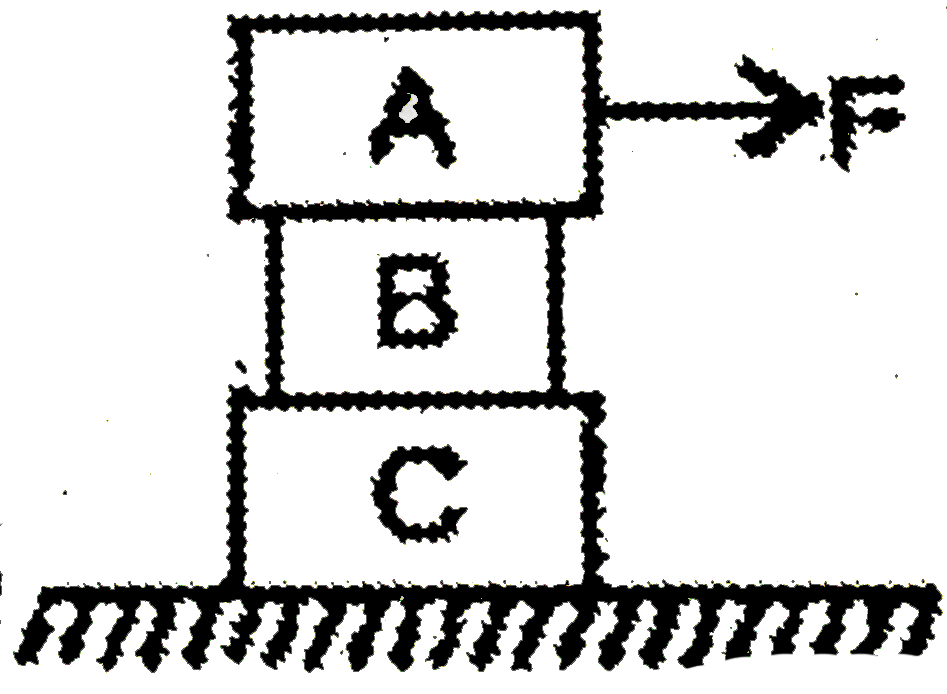
Given `m_(A) = 30 kg, m_(B) = 10 kg, m_(C) = 20 kg`. Between a & B `mu_(1) = 0.3`, between B & C `mu_(2) = 0.2` & between C & ground `mu_(3) = 0.1`. The least horizontal force F to start motion of ant part of the system of three blocks resting upon one another as shown below is :
(Take `g = 10m//s^(2)`)

Promotional Banner

Similar Questions

Explore conceptually related problems

In the arrangement shown in the figure mass m_(A)=2kg, m_(B)=4kg and m_(C)=6kg . Co-efficient of static friction between A and B (mu_(1))=0.4 , between B and C (mu_(2))=0.3 and between C and ground (mu_(3))=0 . A constant force F = 32 N is applied horizontally on block B. Find friction force developed between A and B and that between B and C.

Calculate the horizontal force required to just move a block of mass 40kg resting on the horizontal surface given (mu_s = 0.3) , g = 9.8 m//s^2

Two blocks a and B of mass m_(A)=1kg and m_(B)=3kg are kept on the table as shown in figure the coefficient of friction between A and B is 0.2 and between B and the surface of the table is also 0.2 the maximum force F that can be applied on B horizontally, so that the block A does not slide over the block B is [Take g=10m//s^(2) ]

Calculate the horizontal force required to just move a block of mass 20kg resting on a horizontalsurface (mu_s = 0.3 , g= 9.8m//s^2)

m=20 kg, mu_(s)=0.5 , find friction on block.

In the figure-2.205 shown in blocks A, B and C has masses m_(A)= 5 kg, m_(B) = 5 kg and m_(C )= 10kg respectively, find the acceleration of the three blocks. Assume all pulleys and strings are ideal. (Take g = 10m//s^(2) )

Two blocks of masses m_(1) = 10 kg and m_(2) = 20 kg are connected by a spring of stiffness k = 200 N/m. The coefficient of friction between the blocks and the fixed horizontal surface is mu = 0.1 . Find the minimum constant horizontal force F (in Newton) to be applied to m1 in order to slide the mass m_(2) . (Take g = 10 m//s^(2) )

In the figure shown m_(1)=5 kg,m_(2) = 10 kg & friction coefficient between m_(1) & m_(2) is mu=0.1 and ground is frictionless then :

Two blocks A and B of masses m_(A) = 1kg and m_(B) = 3kg are kept on the table as shown in figure. The coefficient of friction between A and B is 0.2 and between B and the surface of the table is also 0.2. The maximum force F that can be applied on B horizontally, so that the block A does not slide over the block B is ________ (in N): [Take g = 10 m//s^(2) ]

Two blocks M and m are arranged as shown in the diagram The coefficient of friction between the block is mu_(1) = 0.25 and between the ground and M is mu_(2) = (1)/(3) If M = 8 kg then find the value of m so that the system will remain at rest