

Home
Class 12
PHYSICS
Two particles of mass 1 kg and 2 kg are ...

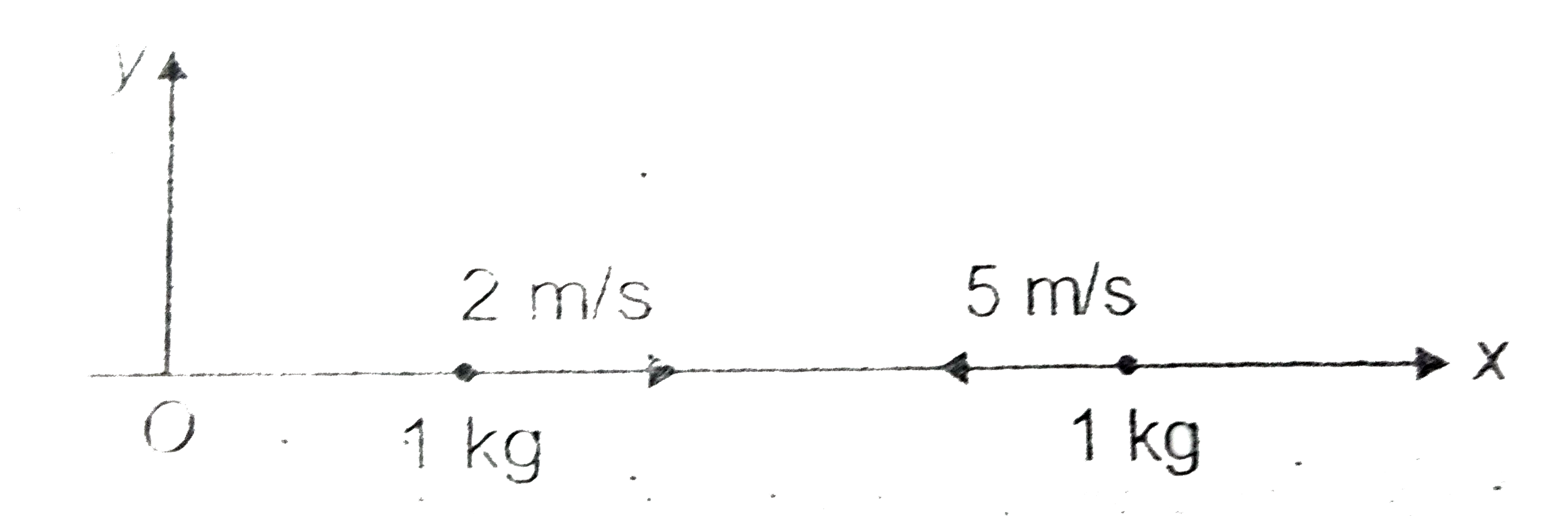
Two particles of mass 1 kg and 2 kg are moving with speed 2 m/s and 5 m/s as shoen in the figure, they collides perfectly inelastically. Find
(a) Their final velocity
(b) Loss in kinetic energy

Promotional Banner

Similar Questions

Explore conceptually related problems

Two particles of mass 1 kg and 2 kg are moving with speed 2 m/s and 5 m/s as shown in the figure, they collides perfectly inelastically. And second particle come to rest after collision. Find (a) Their final velocity (b) Loss in kinetic energy

Two particles A and B of mass 3kg and 2kg moving with speed 10m//s and 5m//s as shown in figure. Kinetic energy of particle A when particle B has the maximum momentum

Two particles A and B of mass 3kg and 2kg moving with speed 10m//s and 5m//s as shown in figure. Kinetic energy of particle A when particle B has the maximum momentum

Two particles A and B of masses 2kg and 3kg moving on a smooth horizontal surface with speed 1m//s and 2m//s collides perfectly inelastically, then

Two particles A and B of masses 2kg and 3kg moving on a smooth horizontal surface with speed 1m//s and 2m//s collides perfectly inelastically, then

Two particles A and B of mass 3kg and 2kg moving with speed 10m//s and 5m//s as shown in figure. Find the maximum momentum that particle B can have after collision with B .

Two particles A and B of mass 3kg and 2kg moving with speed 10m//s and 5m//s as shown in figure. Find the maximum momentum that particle B can have after collision with A

Two particles of mass 2m and m moving with speed v and 2v respectively perpendicular to each other collides perfectly inelastically, then Loss in kinetic energy of the system

Two particles A and B of mass 3kg and 2kg moving with speed 10m//s and 5m//s as shown in figure. Find the maximum momentum that particles A can have after collision with B .

Two particles A and B of mass 3kg and 2kg moving with speed 10m//s and 5m//s as shown in figure. Find the maximum momentum that particles A can have after collision with B .