


Similar Questions
Explore conceptually related problems
Recommended Questions
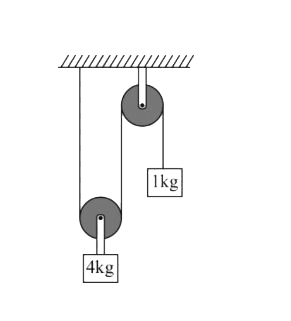
- In the system shown in the adjoining figure, the acceleration of the 1...
Text Solution
|
- In the figure shown, find acceleration of the system and tenslons T(1)...
Text Solution
|
- For the system shown in figure, M=1kg m=0.2 kg, r=0.2m calculate (g=10...
Text Solution
|
- Two bodies of masses 1 kg and 2 kg are moving in two perpendicular dir...
Text Solution
|
- In figure shown if 2 kg block is moving at an acceleration 2 m//s^(2) ...
Text Solution
|
- 200 किग्रा द्रव्यमान की लिफ्ट 3 मी/से ""^(2 ) के त्वरण से ऊपर की और ग...
Text Solution
|
- In figure shown if m(A) = 20 kg and m(B) = 80 kg. The acceleration of ...
Text Solution
|
- In the system shown in the adjoining figure, the acceleration of the 1...
Text Solution
|
- Three masses 1kg,6kg and 3kg are of connected to each other with threa...
Text Solution
|