

Home
Class 11
PHYSICS
A particle A of mass m initially at rest...

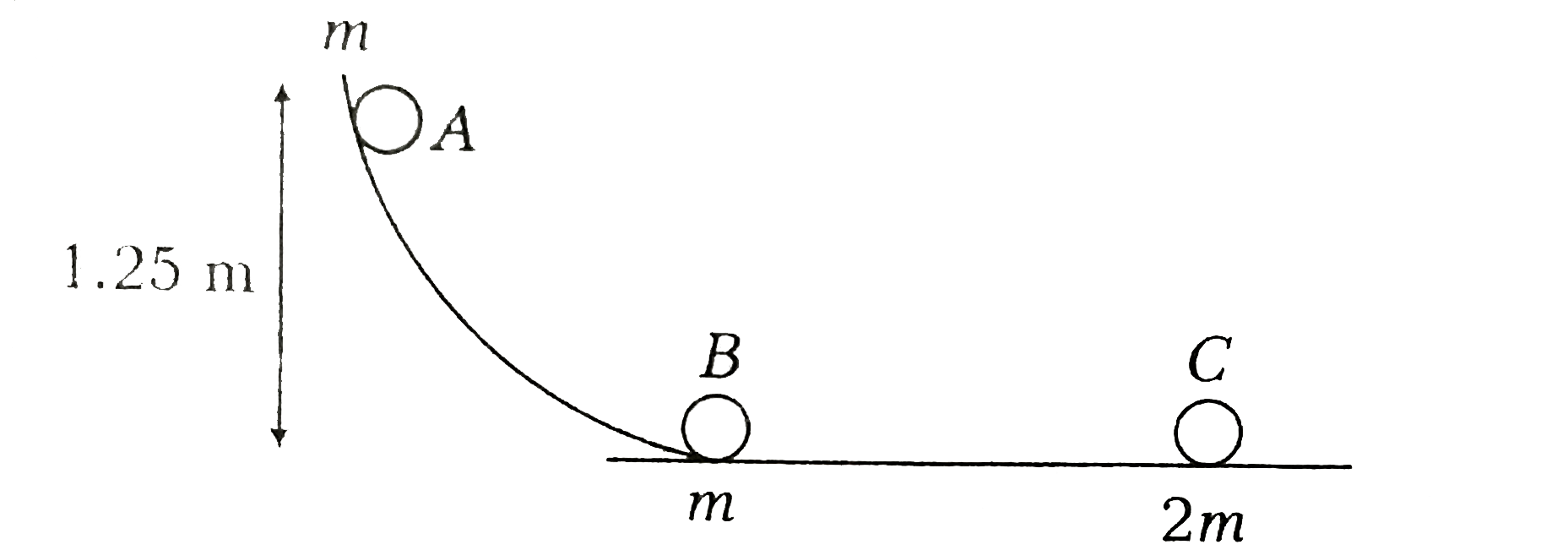
A particle A of mass m initially at rest slides down a height of 1.25 m on a frictionless ramp, collides with and sticks to an identical particles B of mass m at rest as shown in the figure.

Then, particles A and B together collide elastically with particle G of mass 2m at rest. The speed of particle G after the collision with combined body (A+B) would be (Take, g`=10 ms^(-2))`

Promotional Banner

Similar Questions

Explore conceptually related problems

A particle of mass m moving with speed V collides eleastically with another particle of mass 2mFind speed of smaller mass after head on collision

A particle of mass m moving with velocity vecV makes a head on elastic collision with another particle of same mass initially at rest. The velocity of the first particle after the collision will be

Two particle of masses m and 2m are coliding elastically as given in figure. If V_(1) and V_(2) speed of particle just after collision then

A particle of mass m moving with speed u collides perfectly inelastically with another particle of mass 3 m at rest. Loss of KE of system in the collision is

A particle of mass m moving with horizontal speed 6 m//s as shown in the figure. If m lt lt M then for one - dimensional elastic collision , the speed of lighter particle after collision will be

A particle of mass m moving with velocity u collides elastically head on with a particle of mass 2m at rest. After collision the heavier particle moves with velocity?

A particle of mass m strikes another particle of same at rest. Find the angle between velocities of particles after the collision , if the collision is elastic.

A particle of mass m moving with speed u collides perfectly inelastically with another particle of mass 2m at rest. Find loss of kinetic energy of system in the collision.

A particle of mass m and veocity vec(v) collides elastically with a stationary particle of mass m Calculate the angle between velocity vector of the two partiicless after the collision.