

Home
Class 11
PHYSICS
A spring-mass system ( m1 + massless spr...

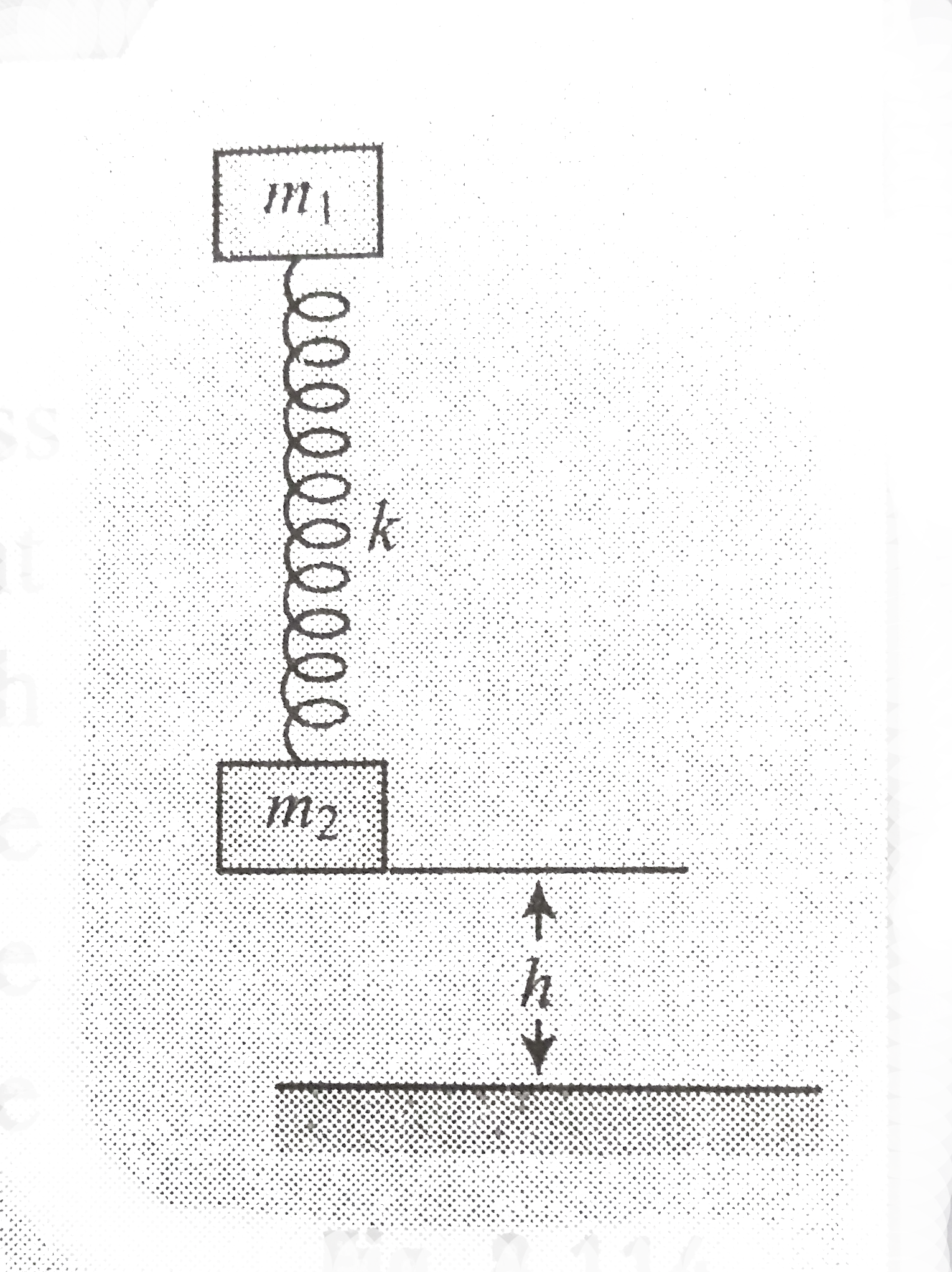
A spring-mass system ( `m_1` + massless spring + `m_2`) fall freely from a height `h` before `m_2` colliding inelastically with the ground. Find the maximum value of `h` so that block `m_2` will break off the surface. Assume k=stiffness of the spring.

Promotional Banner

Similar Questions

Explore conceptually related problems

A spring-mass system ( m_1 + massless spring + m_2 ) fall freely from a height h before m_2 colliding inelastically with the ground. Find the minimum value of h so that block m_2 will break off the surface. Assume k=stiffness of the spring.

A block of mass m is dropped onto a spring of constant k from a height h . The second end of the spring is attached to a second block of mass M as shown in figure. Find the minimum value of h so that the block M bounces off the ground. If the block of mass m sticks to the spring immediately after it comes into contact with it.

A block of mass m is dropped onto a spring of constant k from a height h . The second end of the spring is attached to a second block of mass M as shown in figure. Find the minimum value of h so that the block M bounces off the ground. If the block of mass m sticks to the spring immediately after it comes into contact with it.

In figure, the stiffness of the spring is k and mass of the block is m . The pulley is fixed. Initially, the block m is held such that the elongation in the spring is zero and then released from rest. Find: a. the maximum elongation in the spring. b. the maximum speed of the block m . Neglect the mass of the spring and that of the string. Also neglect the friction.

In figure, the stiffness of the spring is k and mass of the block is m . The pulley is fixed. Initially, the block m is held such that the elongation in the spring is zero and then released from rest. Find: a. the maximum elongation in the spring. b. the maximum speed of the block m . Neglect the mass of the spring and that of the string. Also neglect the friction.

A block of mass 180 g is placed on a spring (spring constant k = 120 N//m ) fixed from below. A ball of mass 20 g is dropped from height 20 m and the collision is completely inelastic. Find the maximum compression of the spring. Neglect the initial compression of the spring due to the block.

A block of mass m initially at rest is dropped from a height h on to a spring of force constant k . the maximum compression in the spring is x then

A block of mass m is relesed from rest from a height h onto a smooth surface of mass M fitted with an ideal spring of stiffness k . find the maximum compression in the spring.

Two blocks of masses m and M connected by a light spring of stiffness k, are kept on a smooth horizontal surface as shown in figure. What should be the initial compression of the spring so that the system will be about to break off the surface, after releasing the block m_1 ?

Two blocks of masses m and M connected by a light spring of stiffness k, are kept on a smooth horizontal surface as shown in figure. What should be the initial compression of the spring so that the system will be about to break off the surface, after releasing the block m_1 ?