

Home
Class 11
PHYSICS
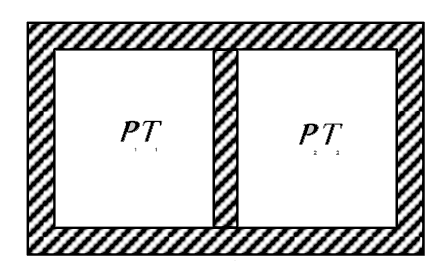
Following figure shows on adiabatic cyli...

Following figure shows on adiabatic cylindrical container of volume `V_(0)` divided by an adiabatic smooth piston (area of cross-section = A ) in two equal parts. An ideal gas `(C_(p)//C_(y)=lambda)` is at pressure P and temperature T in left part and gas at pressure P and temperature T in right part. The piston is slowly displaced and released at a position where it can stay in equilibrium. The final pressure of the two parts will be (Suppose x = displacement of the piston)

Promotional Banner

Similar Questions

Explore conceptually related problems

Following figure shows on adiabatic cylindrical container of volume V_(0) divided by an adiabatic smooth piston (area of cross-section = A ) in two equal parts. An ideal gas (C_(p)//C_(y)=lambda) is at pressure P_1 and temperature T_1 in left part and gas at pressure P_2 and temperature T_2 in right part. The piston is slowly displaced and released at a position where it can stay in equilibrium. The final pressure of the two parts will be (Suppose x = displacement of the piston)

In given figure, an adiabatic cylindrical tube of volume 2V_(0) is divided in two equal parts by a frictionless adiabatic separator. An ideal gas in left side of a tube having pressure P_(1) and temperature T_(1) where as in the right side having pressure P_(2) and temperature T_(2).C_(p)//C_(v) =gamma is the same for both the gases. The separator is slid slowly and is released at a position where it can stay in equilibrium. Find (a) the final volumes of the two parts (b) the heat given to the gas in the left part and (c) the final common pressure of the gases,

In given figure, an adiabatic cylindrical tube of volume 2V_(0) is divided in two equal parts by a frictionless adiabatic separator. An ideal gas in left side of a tube having pressure P_(1) and temperature T_(1) where as in the right side having pressure P_(2) and temperature T_(2).C_(p)//C_(v) =gamma is the same for both the gases. The separator is slid slowly and is released at a position where it can stay in equilibrium. Find (a) the final volumes of the two parts (b) the heat given to the gas in the left part and (c) the final common pressure of the gases,

In given figure, an adiabatic cylindrical tube of volume 2V_(0) is divided in two equal parts by a frictionless adiabatic separator. An ideal gas in left side of a tube having pressure P_(1) and temperature T_(1) where as in the right side having pressure P_(2) and temperature T_(2).C_(p)//C_(v) =gamma is the same for both the gases. The separator is slid slowly and is released at a position where it can stay in equilibrium. Find (a) the final volumes of the two parts (b) the heat given to the gas in the left part and (c) the final common pressure of the gases,

Figure shows an adiabatic cylindrical tube of volume (V_0) divided in two parts by a frictionless adiabatic separator . Initially, the separator is kept in the middle, an ideal gas at pressure (P_1) and the temperatures (T_1) is injected into the left part and the another ideal gas at pressures (P_2) and temperature (T_2) is injected into the right part. (C_p / C_v = gamma) is the same for both the gases. The separator is slid slowly and is released at a position where it can stay in equilibrium. Find (a) the volumes of the parts, (b) the heat given to the gas in the left part and (c) the final common pressure of the gases.

Show a cylindrical tube of volume V_(0) divided in two parts by a frictionless separator. The walls of the tube are adiabatic but the separator is conducting, Ideal gases ate filled in the two parts. When the swparator is kept in the middle, the pressure are p_(1) and p-(2) in the left part and the right part respectively. The separator is slowly slid and is released at a position where it can stay in equilibrium. Find the volumes if the two parts. (figure)

Show a cylindrical tube of volume V_(0) divided in two parts by a frictionless separator. The walls of the tube are adiabatic but the separator is conducting, Ideal gases are filled in the two parts. When the separator is kept in the middle, the pressure are p_(1) and p_(2) in the left part and the right part respectively. The separator is slowly slid and is released at a position where it can stay in equilibrium. Find the volumes if the two parts.

Figure shows an adiabatic cylindrical tube of volume (V_0) divided in two parts by a frictionless adibatic separator . Initially, the separator is kept in the middle, an ideal gas at pressure (p_1) and the temperatures (T_1) is injected into the left part and the another ideal gas at pressures (P_2) and temperature (T_2) is injected into the right part. (C_p / C_v = gamma) is the same for both the gases. The separator is slid slowly and is released at a position where it can stay in equilibrium. Find (a) the volumes of the parts, (b) the heat given to the gas in the left part and (c) the final common pressure of the gases.

A cylindrical container of volume V_(0) is divided into two parts by a thin conducting separator of negligible mass. The walls of the container are adiabatic. Ideal gases are filled in the two parts such that the pressures are P_(0) " and " 2 P_(0) when the separator is held in the middle of the container (see figure). Now the separator is slowly slid and released in a position where it stays in equilibrium. Find the volume of the two parts.

In an adiabatic change, the pressure P and temperature T of a diatomic gas are related by the relation P prop T^C , where C equals to :