

Home
Class 11
PHYSICS
Two identical rings, each of mass M and ...

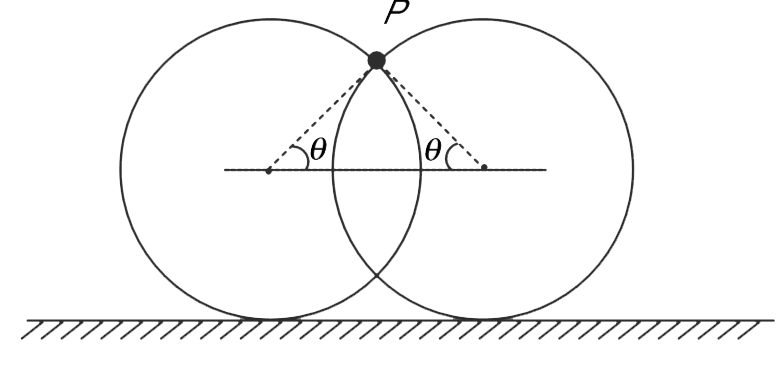
Two identical rings, each of mass M and radius R, are standing on a rough horizontal surface. The rings overlap such that the horizontal line passing through their centre makes an angle of `theta = 45^(@)` with the radius through their intersection point P. A small object of mass m is placed symmetrically on the rings at point P and released. Calculate the acceleration of the centre of the ring immediately after the release. There is no friction between the small object and the rings. The friction between the small object and the rings, and the friction between the rings and the ground is large enough to prevent slipping.

Promotional Banner

Similar Questions

Explore conceptually related problems

For a uniform ring of mass M and radius R at its centre

For a uniform ring of mass M and radius R at its centre

A force F is applied at the top of a ring of mass M and radius R placed on a rough horizontal surface. Friction is sufficient to prevent slipping. Find the frictional force acting on the ring.

Find the moment of inortia of ring of mass m and radius R about an axis passing through its centre and making an angle of 45^(@) with its plane:

Two identical concentric rings each of mass M and radius R are placed perpendicular to each other. What is the moment of inertia about an axis passing through the center of this system and perpendicular to the plane of one of the rings?

From a ring of mass M and radius R, a 30^o sector is removed. The moment of inertia of the remaining portion of the ring, about an axis passing through the centre and perpendicular to the plane of the ring is

Two identical concentric rings each of mass m and radius R are placed perpendicularly. What is the moment of inertia of the system about the axis of one of the rings ?