

Home
Class 11
PHYSICS
Sppose that a point mass 'm' is moving...

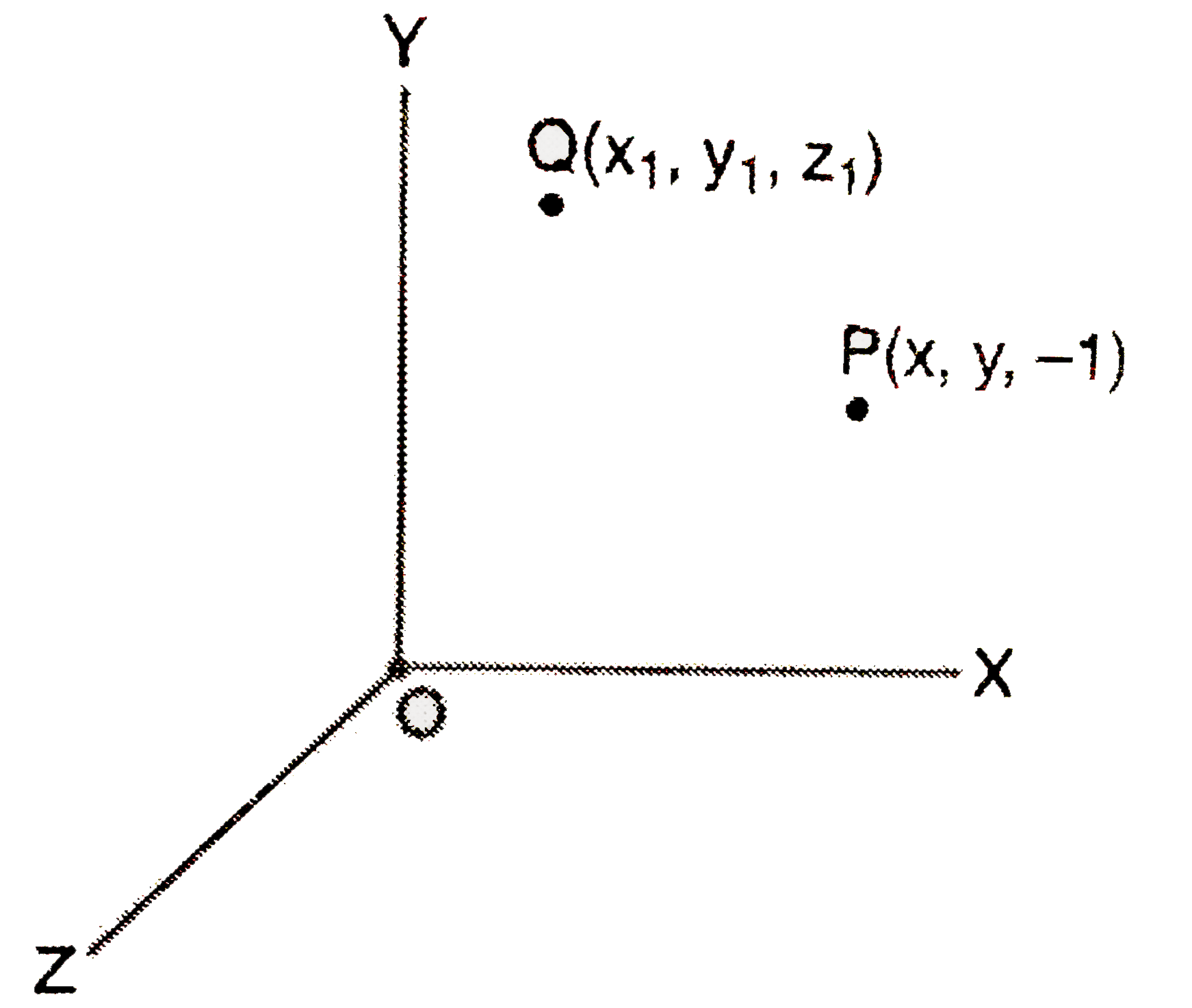
Sppose that a point mass 'm' is moving under a constant force `vecF = 2hati-hatj + hatk` netweon . At some instant , t=0, point P(xm, ym, -1m) [m- metre ] is the instantaneous position of the mass. We know that torque can be expressed as the cross- product of position vector and forces vector, i.e.,
`tau= vecr xx vecF` . At P, torque can be expessed as `tau= (-4hatj - 4 hatk)`Nm At some other instant, t=3 sec, the point mass has another instantaneous position `Q(x_(1), y_(1), z_(1))` such that the displacement vectors between points P and Q and the given force are mutually perpendicular. Also, x-component of torqure at Q is zero and y z-components are equal in magnitude and direction along the negative direction of the respective axes. Using a definite scale, if we construct a parallelogram with the position vectors of Q and the gives force `vecF` as its adjacent sides , area of this parallelogram is `2sqrt(2)m^(2)` . Area of the given parallelogram , in fact , represents a physical quantity whose magnitude in SI system can be expressed as 5 times the gives are

Answer the following questions.
At Q torque acting on the mass can be expressed as :

Promotional Banner

Similar Questions

Explore conceptually related problems

Sppose that a point mass 'm' is moving under a constant force vecF = 2hati-hatj + hatk netweon . At some instant , t=0, point P(xm, ym, -1m) [m- metre ] is the instantaneous position of the mass. We know that torque can be expressed as the cross- product of position vector and forces vector, i.e., tau= vecr xx vecF . At P, torque can be expessed as tau= (-4hatj - 4 hatk) Nm At some other instant, t=3 sec, the point mass has another instantaneous position Q(x_(1), y_(1), z_(1)) such that the displacement vectors between points P and Q and the given force are mutually perpendicular. Also, x-component of torqure at Q is zero and y z-components are equal in magnitude and direction along the negative direction of the respective axes. Using a definite scale, if we construct a parallelogram with the position vectors of Q and the gives force vecF as its adjacent sides , area of this parallelogram is 2sqrt(2)m^(2) . Area of the given parallelogram , in fact , represents a physical quantity whose magnitude in SI system can be expressed as 5 times the gives are Answer the following questions. Work done the for the motion of the points mass from P to Q is :

A force F=(2hati+3hatj+4hatk)N is acting at point P(2m,-3m,6m) find torque of this force about a point O whose position vector is (2hati-5hatj+3hatk) m.

A force F=(2hati+3hatj+4hatk)N is acting at point P(2m,-3m,6m) find torque of this force about a point O whose position vector is (2hati-5hatj+3hatk) m.

A force vecF = (hati+hatj-hatk)N acts at a point P(3 m, 6 m, 9 m). The torque exerted by this force about a point Q(2 m, 7 m, 8 m) is

A force vecF = (hati+hatj-hatk)N acts at a point P(3 m, 6 m, 9 m). The torque exerted by this force about a point Q(2 m, 7 m, 8 m) is

The work done in moving an object from origin to a point whose position vector is vecr = 3hati + 2hatj - 5hatk by a force vecF = 2hati - hatj - hatk is

The work done in moving an object from origin to a point whose position vector is vecr = 3hati + 2hatj - 5hatk by a force vecF = 2hati - hatj - hatk is

A force vecF=(3hati+4hatj)N is acting on a point mass m=((1)/(2))kg at a point A(2m,2m) . Find the angular acceleration of the line OA at this instant.

A force vecF=(3hati+4hatj)N is acting on a point mass m=((1)/(2))kg at a point A(2m,2m) . Find the angular acceleration of the line OA at this instant.