

Home
Class 12
PHYSICS
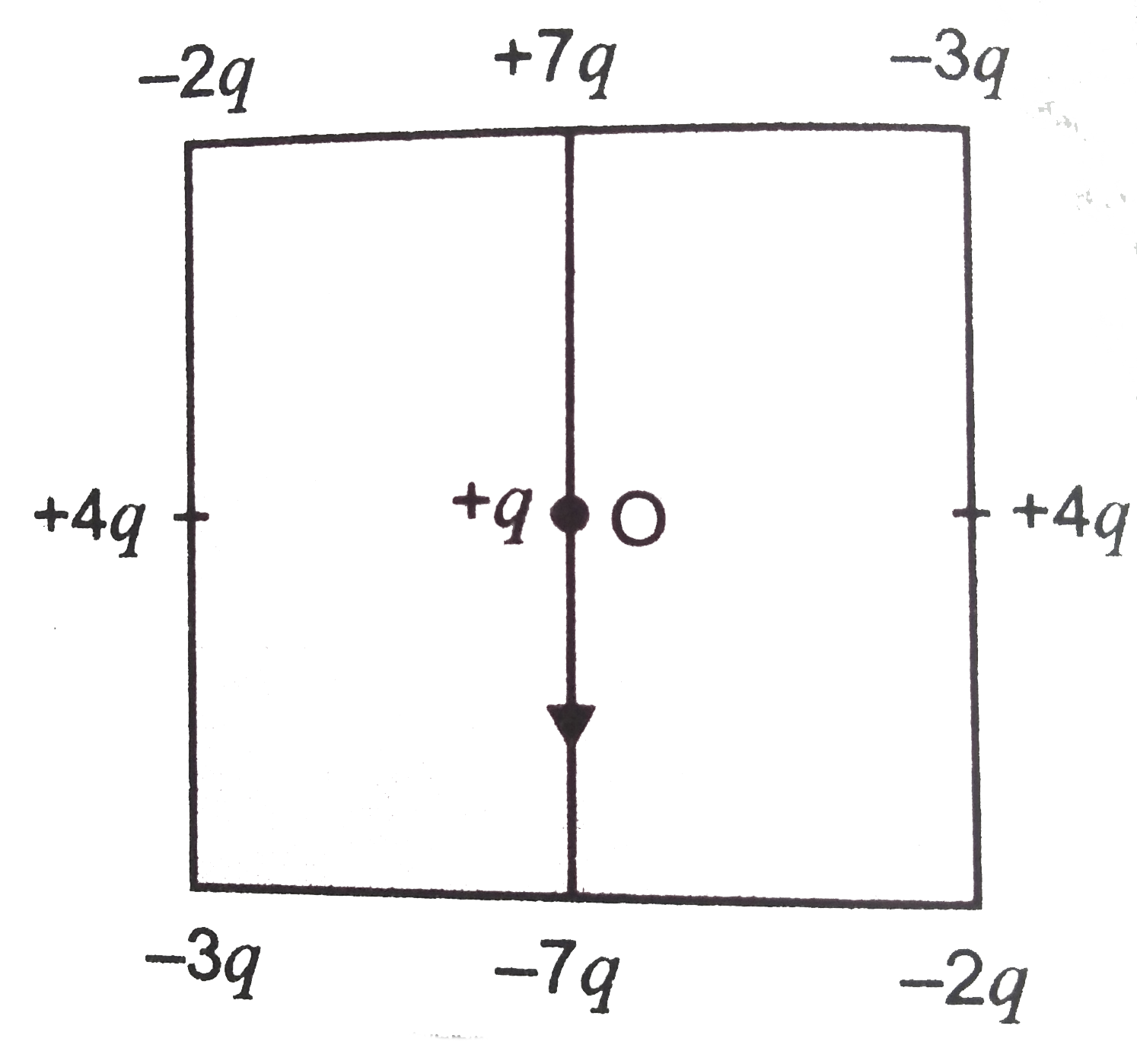
A particle carrying charge + q is hel...

A particle carrying charge + q is held at the center of a square of each side arranged on the square as shown in Fig. 1(a).11. If q = 2 muC, what is the net force on the particle?

Promotional Banner

Similar Questions

Explore conceptually related problems

A particle carrying charge + q is held at the center of a square of each side arranged on the square as shown in Fig. If q = 2 muC, what is the net force on the particle?

Four point charges are placed at the corners of a square ABCD of side 10 cm, as shown in figure. The force on a charge of 1muC placed at the centre of square is

Four point charges are placed at the corners of a square ABCD of side 10 cm, as shown in figure. The force on a charge of 1muC placed at the centre of square is

Four particles, each of mass m and charge q, are held at the vertices of a square of side 'a'. They are released at t = 0 and move under mutual repulsive forces speed of any particle when its distance from the centre of square doubles is

Four particles, each of mass m and charge q, are held at the vertices of a square of side 'a'. They are released at t = 0 and move under mutual repulsive forces speed of any particle when its distance from the centre of square doubles is

Four equal charges are kept fixed on the vertices of a square of side 'a'. A charge q_1 is kept at the centre of the square as shown in the figure . Then

Four charge Q, q, Q and q are kept at the four corners of a square as shown below. What is the relation between Q and q, so that the net force on a charge q is zero ?

Four charge Q, q, Q and q are kept at the four corners of a square as shown below. What is the relation between Q and q, so that the net force on a charge q is zero ?

Consider the charges q, q and -q placed at the vertices of an equilateral triangle as shown in Fig. What is the force on each charge ?

Four small particles charged with equal positive charges Q each are arranged at the four corners of a horizontal square of side a. A unit positive charge mass m is placed at a point P, at a height h above the centre of the square. What should be the magnitude of charge Q in order that the unit charge remain in equilibrium