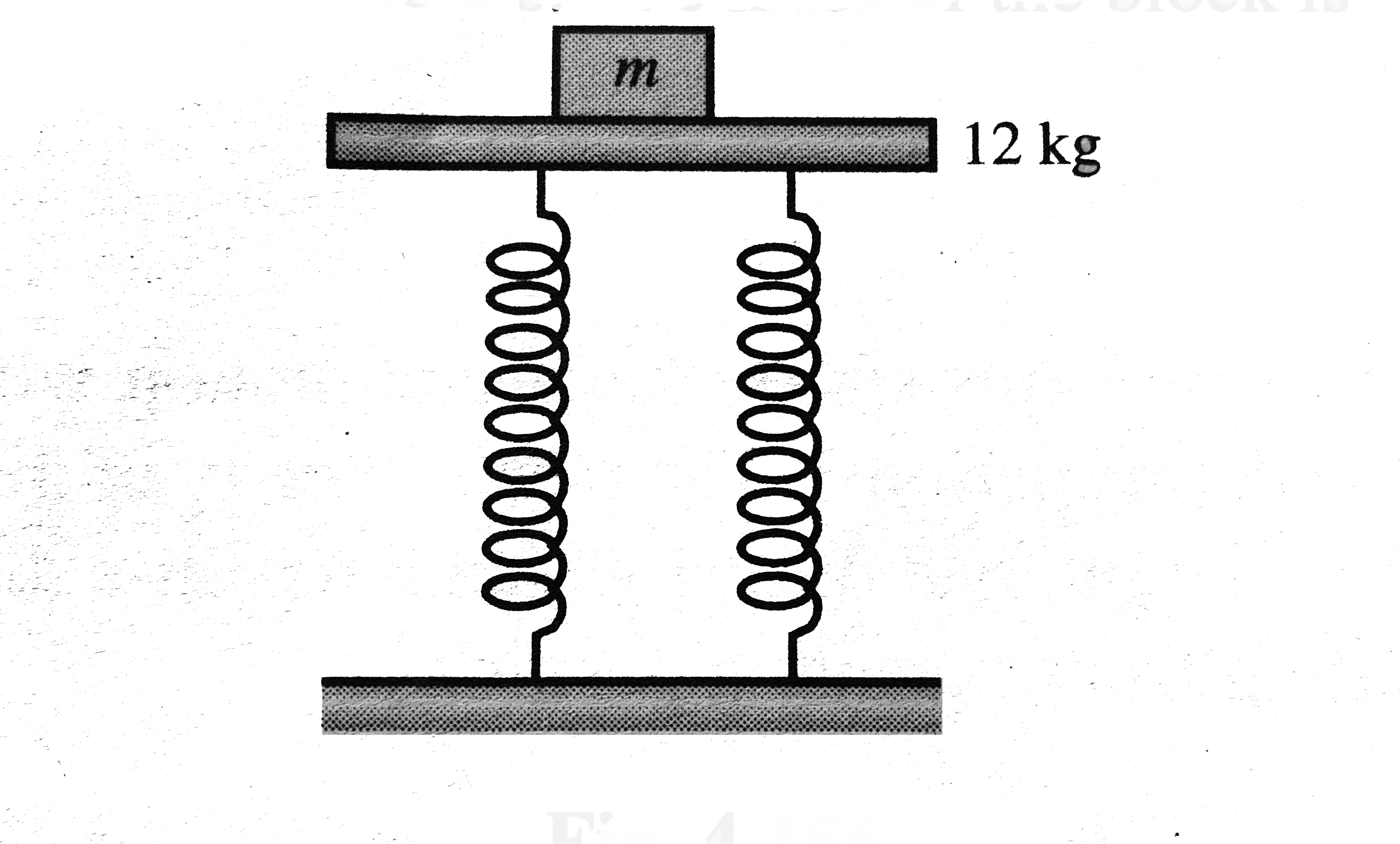
A plank of mass 12 kg is supported by two identical springs as shown is Fig. The plank always remains horizontal. When the plank is pressed down and released it performs simple harmonic motion with time period 3 s. When a block of m is attached to the plank the time priod changes to 6 s. The mass of the block is
A plank of mass 12 kg is supported by two identical springs as shown is Fig. The plank always remains horizontal. When the plank is pressed down and released it performs simple harmonic motion with time period 3 s. When a block of m is attached to the plank the time priod changes to 6 s. The mass of the block is



Similar Questions
Explore conceptually related problems
A tray of mass 12 kg is supported by two identical springs as shown in figure. When the tray is pressed down slightly and released, it executes SHM with a time period of 1.5s. What is the force constant of each spring?When a block of mass m is placed on the tray , the period of SHM changes to 3.0s. What is the mass of the block ?
When a mass m attached to a spring it oscillates with period 4s. When an additional mass of 2 kg is attached to a spring, time period increases by 1s. The value of m is :-
An arrangement of three identical spring and a block of mass 10 kg is shown in the adjoining figure. When the platform on which block is placed is slightly pressed down and released. It performs S.H.M. with a period of 2 s. (i) Calculate the spring constant of the spring. (ii) If a block of mass m is further placed on the platform, the new period of S.H.M. becomes 3.5 s. Find the value of m. (Assume platform to be massless)
A plank of mass M is placed on a smooth hroizonal surface. Two light identical springs each of stiffness k are rigidly connected to structs at the ends of the plank as shown. When the spring are in their unextended position the distance between their free ends is 3l . a block of mass m is placed on the plank and pressed aganist one of the springs so that it is compressed by l . To keep the blocks at rest it is connected to the strut by means of a light string, initially the syetem is at rest. Now the string is burnt. Time period of oscillation of block:
A plank of mass M is placed on a smooth hroizonal surface. Two light identical springs each of stiffness k are rigidly connected to structs at the ends of the plank as shown. When the spring are in their unextended position the distance between their free ends is 3l . a block of mass m is placed on the plank and pressed aganist one of the springs so that it is compressed by l . To keep the blocks at rest it is connected to the strut by means of a light string, initially the syetem is at rest. Now the string is burnt. Maximum displacement of plank is:
A plank of mass 10 kg and a block of mass 2 kg are placed on a horizontal plane as shown in the figure. There is no friction between plane and plank. The coefficient of friction between block and plank is 0.5 .A force of 60 N is applied on plank horizontally. In first 2 s the work done by friction on the block is
A horizontal plank has a rectangular block placed on it. The plank starts oscillating vertically and simple harmonically with an amplitude of 40 cm. The block just loses contact with the plank when the latter is at momentary rest Then.
According to the principle of conservation of linear momentum if the external force acting on the system is zero, the linear momentum of the system will remain conserved. It means if the centre of mass of a system is initially at rest, it will remain at rest in the absence of external force, that is, the displacement of centre of mass will be zero. A plank of mass M is placed on a smooth horizontal surface. light identical springs, each of stiffness K , are rigidly connected to struts at the end of the plank as shown in Fig. When the springs are in their unextended position, the distance between their free ends is 3l . A block of mass m is placed on the plank and pressed against one of the springs so that it is compressed to l . To keep the block at rest it is connected to the strut means of a light string. Initially, the system is at rest, Now the string is burnt. The maximum displacement of the plank is
According to the principle of conservation of linear momentum if the external force acting on the system is zero, the linear momentum of the system will remain conserved. It means if the centre of mass of a system is initially at rest, it will remain at rest in the absence of external force, that is, the displacement of centre of mass will be zero. A plank of mass M is placed on a smooth horizontal surface. light identical springs, each of stiffness K , are rigidly connected to struts at the end of the plank as shown in Fig. When the springs are in their unextended position, the distance between their free ends is 3l . A block of mass m is placed on the plank and pressed against one of the springs so that it is compressed to l . To keep the block at rest it is connected to the strut means of a light string. Initially, the system is at rest, Now the string is burnt. The maximum velocity of the plank is
According to the principle of conservation of linear momentum if the external force acting on the system is zero, the linear momentum of the system will remain conserved. It means if the centre of mass of a system is initially at rest, it will remain at rest in the absence of external force, that is, the displacement of centre of mass will be zero. A plank of mass M is placed on a smooth horizontal surface. light identical springs, each of stiffness K , are rigidly connected to struts at the end of the plank as shown in Fig. When the springs are in their unextended position, the distance between their free ends is 3l . A block of mass m is placed on the plank and pressed against one of the springs so that it is compressed to l . To keep the block at rest it is connected to the strut means of a light string. Initially, the system is at rest, Now the string is burnt. The maximum kinetic energy of the block m is
Recommended Questions
- A plank of mass 12 kg is supported by two identical springs as shown i...
Text Solution
|
- A block of mass m(1) = 1 kg is horizontally thrown with a velocity of ...
Text Solution
|
- A plank of mass 12 kg is supported by two identical springs as shown i...
Text Solution
|
- A horizontal plank has a rectangular block placed on it. The plank sta...
Text Solution
|
- Block A of mass m is placed on a plank B. A light support S is fixed o...
Text Solution
|
- A block of mass m=2kg of shown dimensions is placed on a plank of mass...
Text Solution
|
- Block A of mass m is placed on a plank B . A light support S is fixed ...
Text Solution
|
- A block of mass 2 kg rests on a rough horizontal plank , the coefficie...
Text Solution
|
- A plank of mass 10 kg and a block of mass 2 kg are placed on a horizon...
Text Solution
|