

Home
Class 11
PHYSICS
A block P of mass m is placed on a smoot...

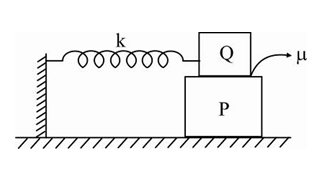
A block P of mass m is placed on a smooth horizontal surface. A block Q of the same mass is placed over the block P and the coefficient of static friction between them is `mu`. A spring of spring constant K is attached to block Q. The blocks are displaced together to a distance A and released. The upper block oscillates without slipping over the lower block. The maximum frictional force between the block is:

Promotional Banner

Similar Questions

Explore conceptually related problems

A block of mass m is placed on a rough horizontal surface. If minimum force to pull the block is (mg)/(2) then coefficient of friction is :

A block of mass m is attached to two unstretched springs of spring constant k , each as shown. The block is displaced towards right through a distance x and is released The speed of the block as it passes through the mean position will be

A block P of mass m is placed on horizontal frictionless plane. A second block of same mass m is placed on it and is connected to a spring of spring constant k, the two blocks are pulled by distance A. Block Q oscillates without slipping. What is the maximum value of frictional force between the two blocks.

On a smooth horizontal surface a block A of mass 10kg is kept. On this block a second block B of mass 5kg is kept. The coefficient of friction between the two blocks is 0.4 .A horizontal force of 30N is applied on the lower block as shown. The force of friction between the blocks is

A block of mass m is placed on a rough horizontal surface. The coefficent of friction between them is mu . An external horizontal force is applied to the block and its magnitude is gradually increased. The force exerted by the block on the surface is R.

A long block A is at rest on a smooth horizontal surface. A small block B, whose mass is half of A, is placed on A at one end and projected along A with some velocity u. The coefficient of friction between the blocks is mu :

A long block A is at rest on a smooth horizontal surface. A small block B whose mass is half of mass of A is placed on A at one end and is given an initial velocity u as shown in figure. The coefficient of friction between the blocks is mu .

A block A of mass 2 kg is placed over smooth block B of mass 4 kg which is placed over a smooth horizontal floor The coefficient of friction between A and B is 0.4 when a horizontal forces of magnitude 10 N is applied on A the acceleration of block of A and B are