

Home
Class 12
MATHS
The hexagonal prism shown above has a re...


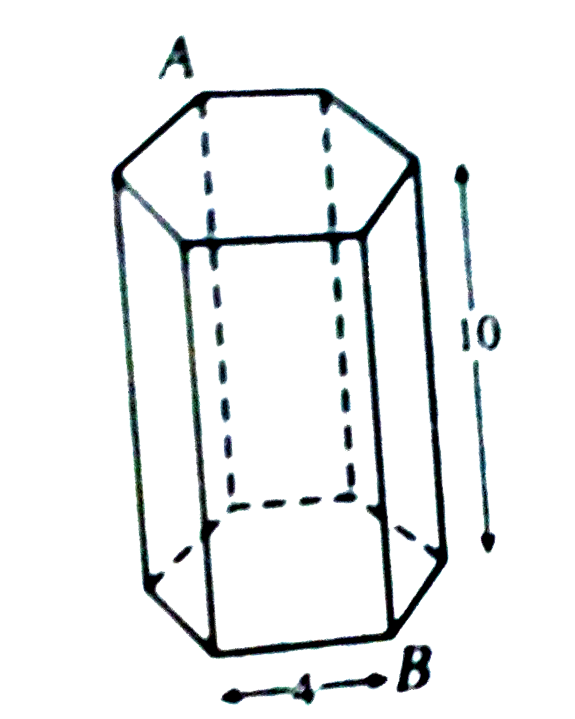
The hexagonal prism shown above has a regular hexagon with side 4 as base. The height of the prism is 10. Let A be a vertex on the "back" face of the prism, while B is a vertex on the "front" face, as shown . What is the length of the diagonal `bar(AB)`, to the nearest tenth ?

Promotional Banner

Similar Questions

Explore conceptually related problems

If base of a prism is a square of side 4 cm, If the height of prism is 10 cm, the what will be total surface area of that prism?

A prism has a regular hexagonal base with side 6 cm. If the total surface area of prism is 216 sqrt""3 cm^(2) . then what is the height (in cm) of prism?

The square pyramid shown above has altitude 6 and side of square base equal to 8. What is the area of one of the triangular faces of the pyramid ?

Height of a prism is 15 cm . Its base is a triangle and the perpendicular sides of the triangle are of lengths 6 cm and 8 cm . a) What is the volume of the prism? b) Find the lateral surface area of the prism.

Draw a prism with its base as regular hexagon with one of its face facing you. Now draw the top view, front view and side view of this solid.

The cross section of a prism is a regular hexagon. A narrow beam of light strikes a face of the prism just below the midpoint (M) of the edge AB. The beam is parallel to the top and bottom faces of the prism. Final the minimum value of refractive index of the material of the prism for which the emergent beam will be parallel to the incident beam.

A right prism has a square base with side of base 4 cm and the height of prism is 9 cm. The prism is cut in three parts of equal heights by two planes parallel to its base. What is the ratio of the volume of the top, middle and the bottom part respectively?

A prism has a square base whose side is 8 cm. The height of prism is 80 cm. The prism is cut into 10 identical parts by 9 cuts which are parallel to base of prism. What is the total surface area (in cm^2 ) of all the 10 parts together?

A ray of light incident normally on one of the faces of a right-angle isosceles prism is found to be totally reflected as shown in the figure. What is the minimum value of the refractive index of the material of the prism? When the prism is immersed in water, trace the path of the emergent ray for the same incident ray, indicating the values of all the angles (mu_omega=4//3) .