

Home
Class 12
PHYSICS
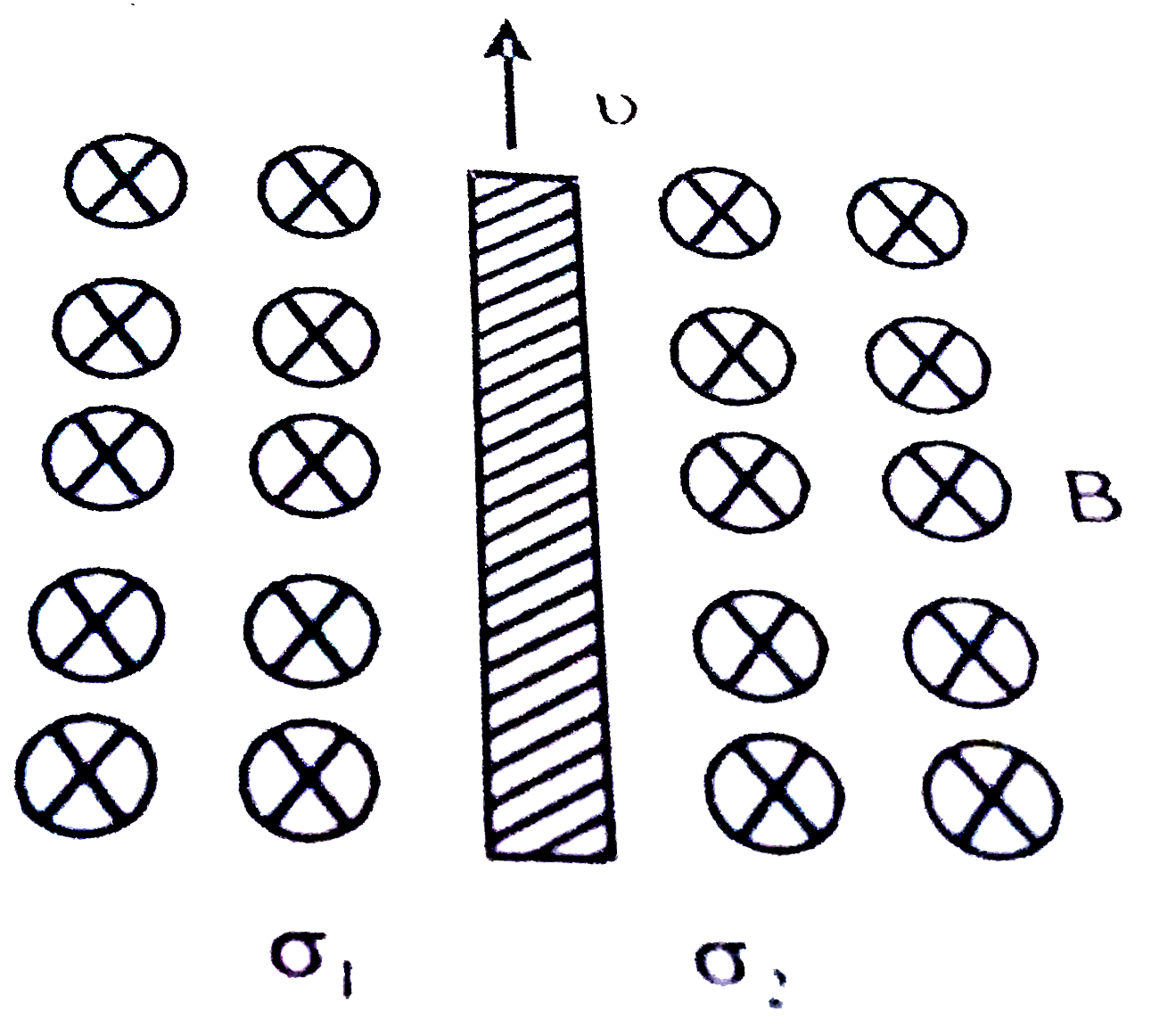
Consider a thin metallic sheet perpendic...

Consider a thin metallic sheet perpendicular to the plane of the paper moving with speed `upsilon` in a uniform magnetic field B going into the plane of the paper (See figure.) If charge densities `sigma_1 and sigma_2` are induced on the left and right surfaces, respectively, of the sheet then (ignore fringe effects.)

Promotional Banner

Similar Questions

Explore conceptually related problems

Two large parallel plane sheets have uniform charge densities + sigma and -sigma. Determine the electric field (i) between the sheets, and (ii) outside the sheets.

Two uniform sheets of charge with surface charge densities +sigma and -sigma are intersecting at right angles to each other. Electric field intensity due to this system is

Use Gauss' theorem to find the electric field due to a uniformly charged infinitely large plane thin sheet with surface charge density sigma .

Two plane sheets of charge densities +sigma and -sigma are kept in air as shown in Fig. What are electric field intensities at points A and B ?

A particle with charge q moving with a velocity v in the plane of the paper enters a uniform magnetc field B, acting perpendicular to the plane of the paper. Deduce an expression for the tie period of the charge, as it moves in a circular path in the field. Why does the kinetic energy of the charge not change, while moving in the magnetic field?

Three infinite plane sheets carrying uniform charge densities -sigma , 2 sigma , 4 sigma are placed parallel to XZ plane at Y = a, 3a, 4a respectively. The electric field at the point (0, 2a, 0) is

A uniform magnetic field exists in the plane of paper pointing from left to right as shown in figure. In the field, an electron and a proton move as shown. The electron and the proton experience:

A uniform magnetic field exists in the plane of paper pointing from left to right as shown in figure. In the field, an electron and a proton move as shown. The electron and the proton experience:

There is a magnetic field acting in a plane perpendicular to this sheet of paper, downward into the paper as shown in the figure. Paticles in acuum move in the plane of the paper from left to right. The path indicated by the arrow could be travelled by