

Home
Class 11
PHYSICS
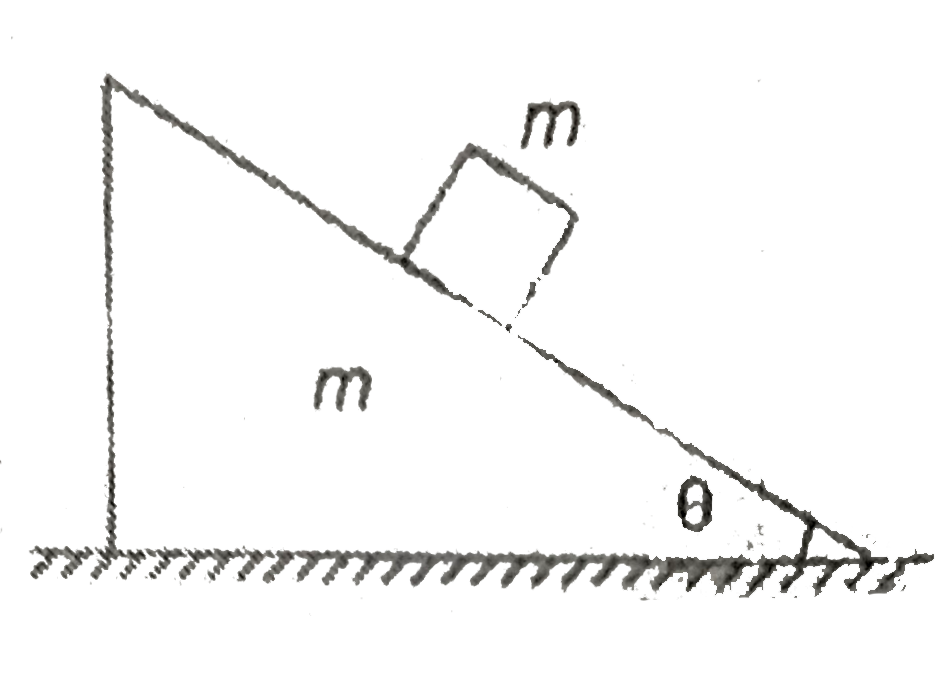
A block of mass m slides down on incline...

A block of mass m slides down on inclined wedge of same mass m as shown in figure . Friction is absent everywhere . Acceleration of centre of mass of the block and wedge is

Promotional Banner

Similar Questions

Explore conceptually related problems

A block of mass m is placed on a smooth wedge of mass M, as shown in the figure . Just after placiing block m over wedge M.

A block of mass m is released from a wedge of mass m as shown in figure . Find the time taken by the block to reach the end of the wedge.

A block of mass m is released from a wedge of mass m as shown in figure . Find the time taken by the block to reach the end of the wedge.

A block of mass m is place on a sm ooth inclined wedge ABC of inclination 0 as shown in figure. The wedge is given an acceleration ‘a’ towards the right. The relation between a and theta for the block to rem ain stationary on the wedge is

A block of mass m slides down a wedge of mass M as shown . The whole system is at rest , when the height of the block is h above the ground. The wedge surface is smooth and gradually flattens. There is no friction between wedge and ground. If there is no friction any where, the speed of the wedge, as the block leaves the wedge is :

A block of mass m slides down a wedge of mass M as shown . The whole system is at rest , when the height of the block is h above the ground. The wedge surface is smooth and gradually flattens. There is no friction between wedge and ground. If there is no friction any where, the speed of the wedge, as the block leaves the wedge is :

A block of mass m slides down a wedge of mass M as shown . The whole system is at rest , when the height of the block is h above the ground. The wedge surface is smooth and gradually flattens. There is no friction between wedge and ground. If there would have been friction wedge and block , which of the following quantities would still remains conserved ?

A block of mass m slides down a wedge of mass M as shown . The whole system is at rest , when the height of the block is h above the ground. The wedge surface is smooth and gradually flattens. There is no friction between wedge and ground. If there would have been friction wedge and block , which of the following quantities would still remains conserved ?

A block of mass m slides down a wedge of mass M as shown . The whole system is at rest , when the height of the block is h above the ground. The wedge surface is smooth and gradually flattens. There is no friction between wedge and ground. As the block slides down, which of the following quantities associated with the system remains conserved ?

A block of mass m slides down a wedge of mass M as shown . The whole system is at rest , when the height of the block is h above the ground. The wedge surface is smooth and gradually flattens. There is no friction between wedge and ground. As the block slides down, which of the following quantities associated with the system remains conserved ?