

Home
Class 11
PHYSICS
A wall is inclined to a horizontal surfa...

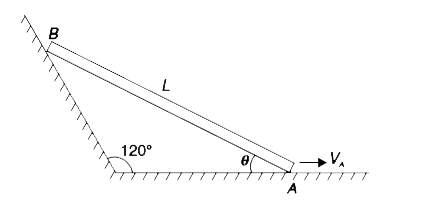
A wall is inclined to a horizontal surface at an angle of `120^(@)` as shown. A rod AB of length `L = 0.75 m` is sliding with its two ends A and B on the horizontal surface and on the wall respectively. At the moment angle `theta = 20^(@)` (see figure), the velocity of end A is `v_(A) = 1.5` m/s towards right. Calculate the angular speed of the rod at this instant. [Take `cos 40^(@) = 0.766` ]

Promotional Banner

Similar Questions

Explore conceptually related problems

A rod of length 1m is sliding in a corner as shown. At an instant when the rod makes an angle of 60^(@) with the horizontal plane, the velocity of point A on the rod is 1 m/s. The angular velocity of the rod at this instant is :

A rod of length 1m is sliding in a corner as shown. At an instant when the rod makes an angle of 60^(@) with the horizontal plane, the velocity of point A on the rod is 1 m/s. The angular velocity of the rod at this instant is :

In the figure shown, the instantaneous speed of end A of the rod is v to the left. The angular velocity of the rod of length L must be

In the figure shown, the instantaneous speed of end A of the rod is v to the left. The angular velocity of the rod of length L must be

A rod length L is held vertically on a smooth horizontal surface. The top end of the rod is given a gentle push. At a certain instant of time, when the rod makes an angle theta with horizontal the velocity of COM of the rod is v_(0) . The velocity of the end of the rod in contact with the surface at that instant is:

A rod AB length 5 m which remains in vertical plane has its ends A and B constrained to remain contact with a horizontal floor and a vertical wall respectively. Determine the velocity of the end B and angular velocity at the position shown in Fig. , if the point A has a velocity of 3ms^(1) rightward.

A rod AB length 5 m which remains in vertical plane has its ends A and B constrained to remain contact with a horizontal floor and a vertical wall respectively. Determine the velocity of the end B and angular velocity at the position shown in Fig. , if the point A has a velocity of 3ms^(1) rightward.

A rod of length L is held vertically on a smooth horizontal surface. The top end of the rod is given a gentle push. At at certain instant of time, when the rod makes an angle 37^@ with horizontal the velocity of COM of the rod of 2m//s . The velocity of the end of the rod in contact with the surface at that instant is

A rod of length L is held vertically on a smooth horizontal surface. The top end of the rod is given a gentle push. At at certain instant of time, when the rod makes an angle 37^@ with horizontal the velocity of COM of the rod of 2m//s . The velocity of the end of the rod in contact with the surface at that instant is

A uniform rod AB of mass m and length l is at rest on a smooth horizontal surface. An impulse p is applied to the end B. The time taken by the rod to turn through a right angle is