

Home
Class 12
PHYSICS
A triangular plate has two cavitiesone t...

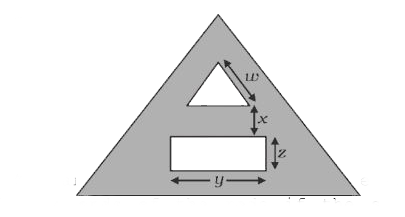
A triangular plate has two cavitiesone triangle and other rectangle. The plate is heated :

Promotional Banner

Similar Questions

Explore conceptually related problems

A triangular plate has two cavities , one square and one rectangular as shown in figure . The plate is heated.

A triangular plate has two cavities , one square and one rectangular as shown in figure . The plate is heated.

A triangular plate has two cavities , one square and one rectangular as shown in figure . The plate is heated.

There is a rectangular metal plate in which two cavities in the shape of rectangle and circle are made, as shown with dimensions. P and Q are the centres of these cavities. On heating the plate, which of the following quantities increases?

There is a rectangular metal plate in which two cavities in the shape of rectangle and circle are made, as shown with dimensions. P and Q are the centres of these cavities. On heating the plate, which of the following quantities increases?

Gravitational potential at point 'P' due to triangular plate is V_0 . Find the gravitational potential due to the given plate at point 'Q' as shown in figure. (both plates are made by same meterial)

Two uniform plates of the same thickness and area but of different materials, one shaped like an isosceles triangle and the other shaped like a rectangle are joined together to form a composite body as shown in the figure. If the centre of mass of the composite body is located at the midpoint of their common side, the ratio between masses of the triangle to that of the rectangle is -

Mass is distributed uniformly over a thin triangular plate and positions of two vertices are given by (1,3) and (2,-4) .What is the position of 3 rd vertex if centre of mass of the plate lies at the origin?

Consider a uniform rectangular plate. If a straight line is drawn, passing through its centre of mass (in the plane of the plate), so as to cut the plate in two parts – the two parts obtained are of equal mass irrespective of the orientation of the line. Can you also say that a straight line passing through the centre of mass of a triangular plate, irrespective of its orientation, will also divide the triangle into two pieces of equal mass ?