

Home
Class 12
PHYSICS
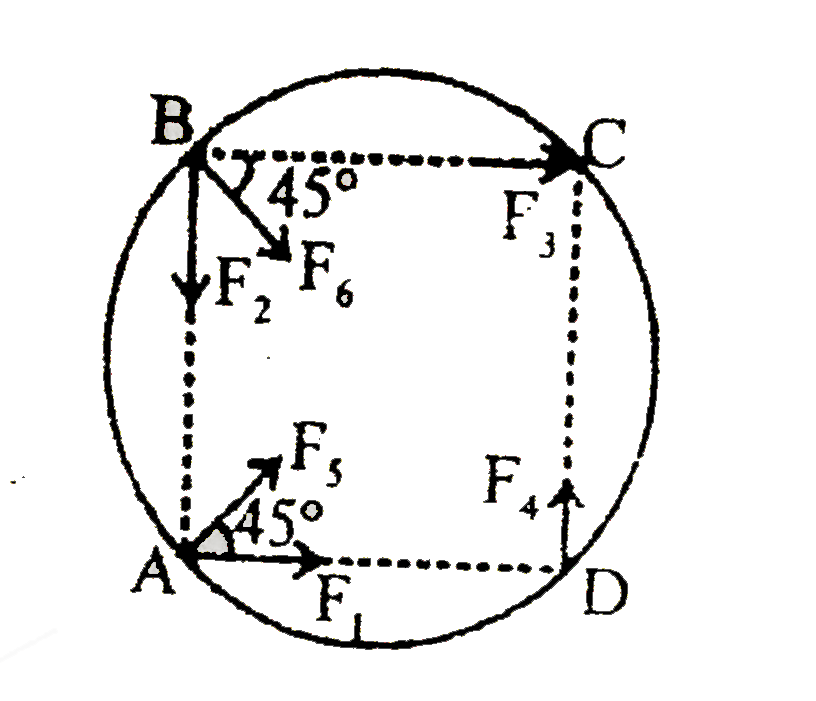
The figure shows a ring in which a squa...

The figure shows a ring in which a square is inscribed. Four equal forces `vec(F)_(1), vec(F)_(2), vec(F)_(3), vec(F)_(4)` of magnitude `10 N` each act at A, B, C, D. Two force `F_(5)` and `F_(6)` of magnitude `10 sqrt2 N` each act at A and B. The ring will

Promotional Banner

Similar Questions

Explore conceptually related problems

When force vec(F_(1)), vec(F_(2)),vec(F_(3))"…..."vec(F_(n)) act on a particle , the particle remains in equilibrium . If vec( F_(1)) is now removed then acceleration of the particle is

When force vec(F)_(1),vec(F)_(2),vec(F)_(3) are acting on a particle of mass m , the particle remains in equilibrium. If the force vec(F)_(1) is now removed then the acceleration of the particle is :

Three forces vec(F)_(1), vec(F)_(2) and vec(F)_(3) are represented as shown. Each of them is equal magnitude. Now match the given columns and select the correct option from the codes given below.

Three forces vec(F)_(1), vec(F)_(2) and vec(F)_(3) are represented as shown. Each of them is equal magnitude. Now match the given columns and select the correct option from the codes given below.

A moving particle of mass m is acted upon by five forces vec(F)_(1),vec(F)_(2),vec_(F)_(3),vec(F)_(4) and vec(F)_(5 . Forces vec(F)_(2) and vec(F)_(3) are conservative and their potential energy functions are U and W respectively. Speed of the particle changes from V_(a) to V_b when it moves from position a to b. Which of the following statement is/are true – (a) Sum of work done by vec(F)_(1),vec(F)_(4) and vec(F)_(5)=U_(b)-U_(a)+W_(b)-W_(a) (b) Sum of work done by vec(F)_(1),vec(F)_(4) and vec(F)_(5)=U_(b)-U_(a)+W_(b)-W_(a)+1/2m(V_(a)^(2)-V_(a)^(2)) (c) Sum of work done by all five forces =1/2m(V_(b)^(2)-V_(a)^(2)) (d) Sum of work done by vec(F)_(2) and vec(F)_(3)=(U_(b)+W_(b))-(U_(a)+W_(a))

A smooth track is in the form of a quarter circle of radius 10 m lies in the vertical plane. A bead moves from A and B along the circular track under the action of forces vec(F)_(1),vec(F)_(2) and vec(F)_(3) Force vec(F)_(1) acts always towards point B and is always 20 N in magnitude Force vec(F)_(2) always acts horizontally and is always 25 N in magnitude. Force vec(F)_(3) always acts tangentially to the track and is of constant magnitude 10 N. Select the correct answer.

A smooth track is in the form of a quarter circle of radius 10 m lies in the vertical plane. A bead moves from A and B along the circular track under the action of forces vec(F)_(1),vec(F)_(2) and vec(F)_(3) Force vec(F)_(1) acts always towards point B and is always 20 N in magnitude Force vec(F)_(2) always acts horizontally and is always 25 N in magnitude. Force vec(F)_(3) always acts tangentially to the track and is of constant magnitude 10 N. Select the correct answer.

Two forces vec(F_(1)) and vec(F_(2)) are acting at right angles to each other , find their resultant ?

A smooth track in the form of a quarter circle of radius 6 m lies in the vertical plane. A particle moves from P_(1) to P_(2) under the action of forces vec F_(1),vecF_(2) and vec F_(3) Force vec F_(1) is always 30 N in magnitude. Force vec F_(3) always acts tangentiallly to the track and is of magnitude 15 N . Select the correct alternative (s) : .

A smooth track in the form of a quarter circle of radius 6 m lies in the vertical plane. A particle moves from P_(1) to P_(2) under the action of forces vec F_(1),vecF_(2) and vec F_(3) Force vec F_(1) is 20N, Force vec F_(2) is always 30 N in magnitude. Force vec F_(3) always acts tangentiallly to the track and is of magnitude 15 N . Select the correct alternative (s) : .