

Home
Class 12
PHYSICS
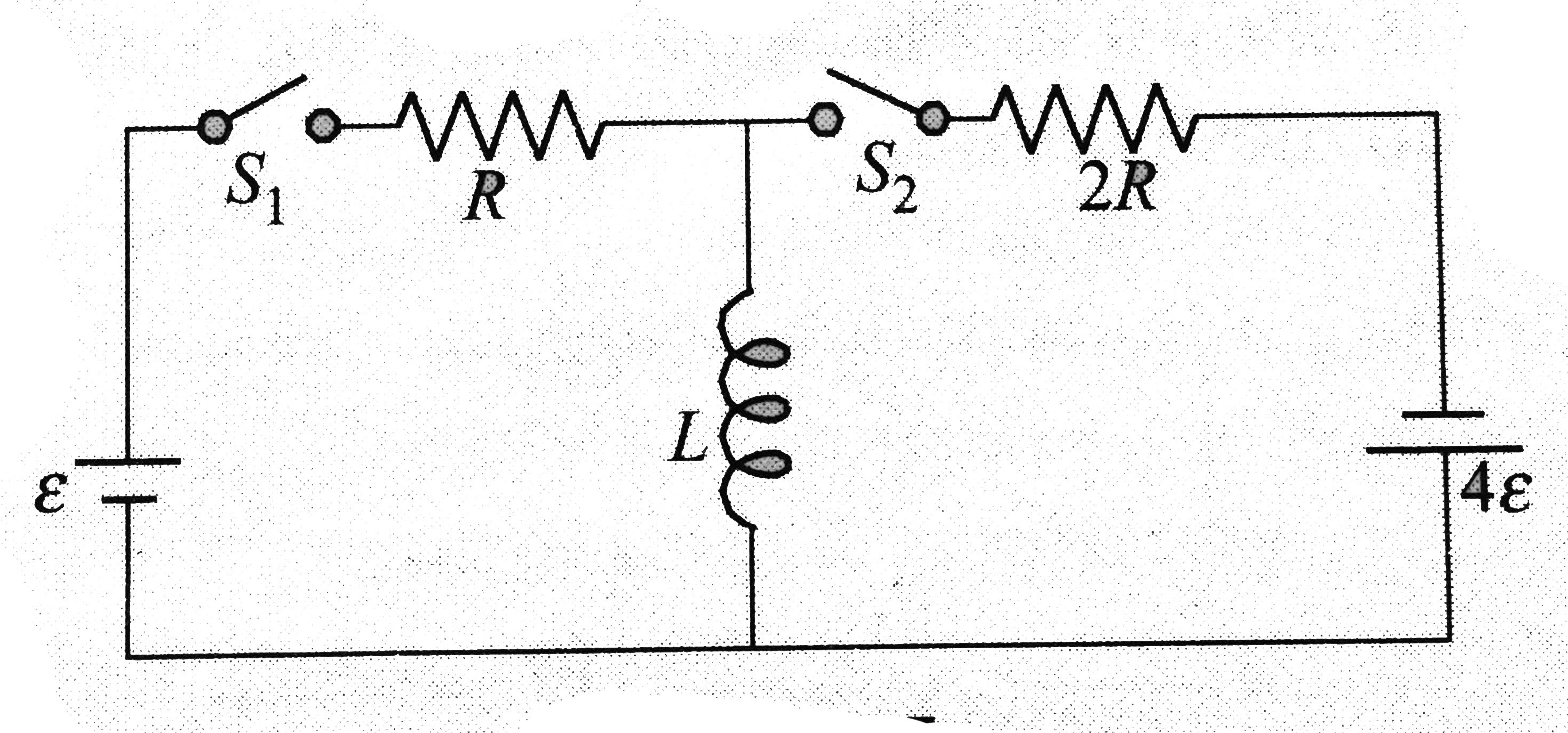
In a circuit S(1) remains closed for a l...

In a circuit `S_(1)` remains closed for a long time and `S_(2)` remain open. Now `S_(2)` is closed and `S_(1)` is opened. Find out the `di//dt` in the right loop just after the moment.

Promotional Banner

Similar Questions

Explore conceptually related problems

At t =0 switch S_1 is closed and remains closed for a long time and S_2 remains open. Now S_1 is opened and S_2 is closed. Find out Charge on the capacitor long after that moment.

At t=0 switch S_(1) is closed and remains closed for a long time and S_(2) remains open. Now S_(1) is opened and S_(2) is closed. Find out (i) The current through the capacitor immediately after that moment (ii) Charge on the capacitor long after that moment. (iii) Total charge flown through the cell of emf 2_(epsilon) after S_(2) is closed.

At t=0 switch S_(1) is closed and remains closed for a long time and S_(2) remains open. Now S_(1) is opened and S_(2) is closed. Find out (i) The current through the capacitor immediately after that moment (ii) Charge on the capacitor long after that moment. (iii) Total charge flown through the cell of emf 2_(epsilon) after S_(2) is closed.

At t =0 switch S_1 is closed and remains closed for a long time and S_2 remains open. Now S_1 is opened and S_2 is closed. Find out The current through the capacitor immediately after that moment

At t =0 switch S_1 is closed and remains closed for a long time and S_2 remains open. Now S_1 is opened and S_2 is closed. Find out Total charge flown through the cell of emf 2epsi" after "S_2 is closed.

The capacitor 'C' is initially unchanged. Switch S_(1) is closed for a long time while S_(2) remains open. Now at t = 0 S_(2) is closed while S_(1) is opened. All the batteries are ideal and connecting wires are resistanceless

The capacitor 'C' is initially unchanged. Switch S_(1) is closed for a long time while S_(2) remains open. Now at t = 0 S_(2) is closed while S_(1) is opened. All the batteries are ideal and connecting wires are resistanceless

In the circuits shows in S_(1) and S_(2) are switches. S_(2) remains closed for a long time and S_(1) is opened. Now S_(1) is also closed. Just after S_(1) is closed, find the potential difference (V) across R and di//dt (with sign) in L .