

Home
Class 12
PHYSICS
A uniform rod of mass M and length L, ar...

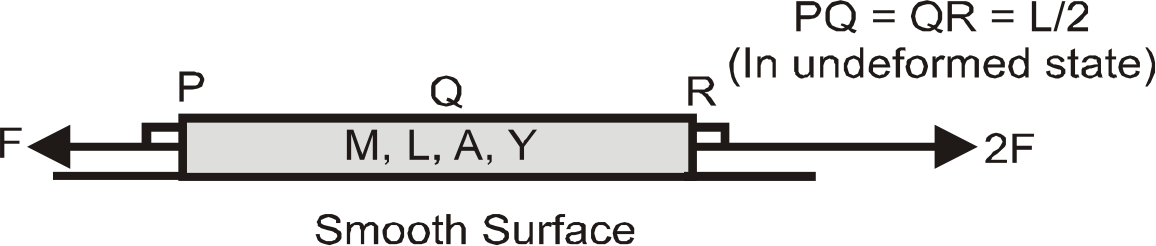
A uniform rod of mass M and length L, area of cross section A is placed on a smooth horizontal surface. Forces acting on the rod are shown in the digram

Ratio of elongation in section PQ of rod and section QR of rod is

Promotional Banner

Similar Questions

Explore conceptually related problems

A uniform rod of mass M and length L, area of cross section A is placed on a smooth horizontal surface. Forces acting on the rod are shown in the digram Ratio of elastic potential energy stored in section PQ and section QR of the rod is

A uniform rod of mass M and length L, area of cross section A is placed on a smooth horizontal surface. Forces acting on the rod are shown in the digram Total elastic potential energy stored in the rod is :

A uniform rod of mass M and length L, area of cross section A is placed on a smooth horizontal surface. Forces acting on the rod are shown in the digram Total elastic potential energy stored in the rod is :

A uniform rod of mass m, length L, area of cross-section A and Young's modulus Y hangs from the ceiling. Its elongation under its own weight will be

A rod of length l , mass M , cross section area A is placed on a rough horizonatal surface. A horizonatal force F is applied to rod as shwon in figure. The coefficient of fricition between rod and surface is mu , the Young, modulus of material of rod is Y . [Assume that fricition force is distributed uniformly on rod] The elongation in the rod if F lt mu Mg is

A rod of length l , mass M , cross section area A is placed on a rough horizonatal surface. A horizonatal force F is applied to rod as shwon in figure. The coefficient of fricition between rod and surface is mu , the Young, modulus of material of rod is Y . [Assume that fricition force is distributed uniformly on rod] Teh elongation in rod if F gt mu Mg is

A uniform rod of mass m and length l is lying on a smooth table. An impulse J acts on the rod momentarily as shown in figure at point R. Just after that:

A uniform cylindrical rod of length L and cross-sectional area by forces as shown in figure. The elongation produced in the rod is