

Home
Class 11
PHYSICS
A uniform rod of length L and mass M is ...

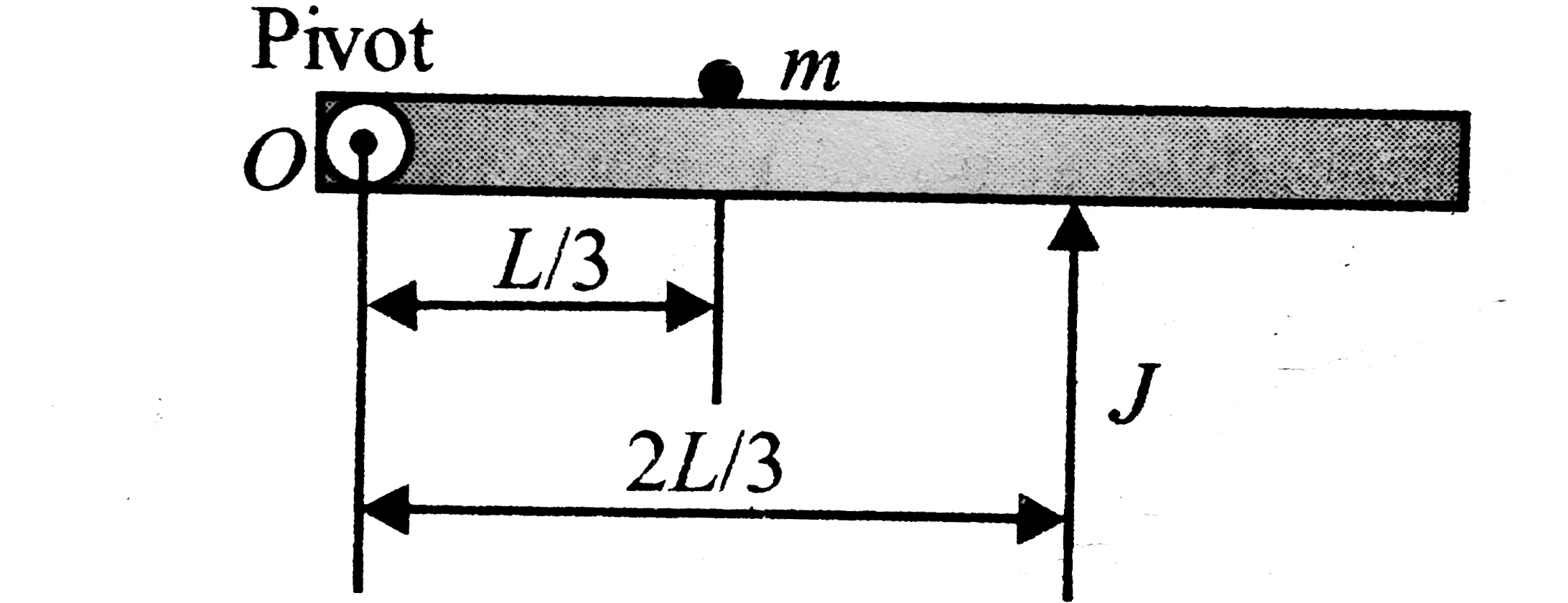
A uniform rod of length `L` and mass `M` is lying on a frictionless horizontal plane and is pivoted at one of its ends as shown in Fig. There is no friction at the pivot. An inelastic ball of mass `m` is fixed with the rod at a distance `L//3` from `O`. A horizontal impulse `J` is given to the rod at a distance `2L//3` from `O` in a direction perpendicular to the rod. Assume that the ball remains in contact with the rod after the collision and impulse `J` acts for a small time interval `/_\t`. Now answer the following questions:

Find the resulting instantaneous angular velocity of the rod after the impulse.

Promotional Banner

Similar Questions

Explore conceptually related problems

A uniform rod of length L and mass M is lying on a frictionless horizontal plane and is pivoted at one of its ends as shown in Fig. There is no friction at the pivot. An inelastic ball of mass m is fixed with the rod at a distance L//3 from O . A horizontal impulse J is given to the rod at a distance 2L//3 from O in a direction perpendicular to the rod. Assume that the ball remains in contact with the rod after the collision and impulse J acts for a small time interval /_\t . Now answer the following questions: Find the impulse acted on the ball during the time /_\t

A uniform rod of length L and mass M is lying on a frictionless horizontal plane and is pivoted at one of its ends as shown in Fig. There is no friction at the pivot. An inelastic ball of mass m is fixed with the rod at a distance L//3 from O . A horizontal impulse J is given to the rod at a distance 2L//3 from O in a direction perpendicular to the rod. Assume that the ball remains in contact with the rod after the collision and impulse J acts for a small time interval /_\t . Now answer the following questions: Find the impulse acted on the ball during the time /_\t

A uniform rod of length L and mass M is lying on a frictionless horizontal plane and is pivoted at one of its ends as shown in Fig. There is no friction at the pivot. An inelastic ball of mass m is fixed with the rod at a distance L//3 from O . A horizontal impulse J is given to the rod at a distance 2L//3 from O in a direction perpendicular to the rod. Assume that the ball remains in contact with the rod after the collision and impulse J acts for a small time interval /_\t . Now answer the following questions: Find the magnitude of the impulse applied on the pivot during the time interval /_\t

A uniform rod of length L and mass M is lying on a frictionless horizontal plane and is pivoted at one of its ends as shown in Fig. There is no friction at the pivot. An inelastic ball of mass m is fixed with the rod at a distance L//3 from O . A horizontal impulse J is given to the rod at a distance 2L//3 from O in a direction perpendicular to the rod. Assume that the ball remains in contact with the rod after the collision and impulse J acts for a small time interval /_\t . Now answer the following questions: Find the magnitude of the impulse applied by the during the time interval /_\t

A uniform thin rod of length 2L and mass m lies on a horizontal table. A horizontal impulse J is given to the rod at one red. There is no friction. The total kinetic energy of the rod just after the impulse will be

A uniform rod of length L and mass m is free to rotate about a frictionless pivot at one end as shown in figure. The rod is held at rest in the horizontal position and a coin of mass m is placed at the free end. Now the rod is released The reaction on the coin immediately after the rod starts falling is

A uniform rod of length L and mass m is free to rotate about a frictionless pivot at one end as shown in figure. The rod is held at rest in the horizontal position and a coin of mass m is placed at the free end. Now the rod is released The reaction on the coin immediately after the rod starts falling is

A uniform rod OA of mass M and length 2a rests on a smooth table and is free to turn about a smooth pivot at its end O, in contact with it at a distance b from O is an inelastic particle of mass m, a horizontal blow of impulse p is given to rod at a distance x from O in a direction perpendicular to the rod. The resultant intantaneous angular velocity of the rod is

A uniform thin rod of length l and mass m is hinged at a distance l//4 from one of the end and released from horizontal position as shown in Fig. The angular velocity of the rod as it passes the vertical position is