

Home
Class 11
PHYSICS
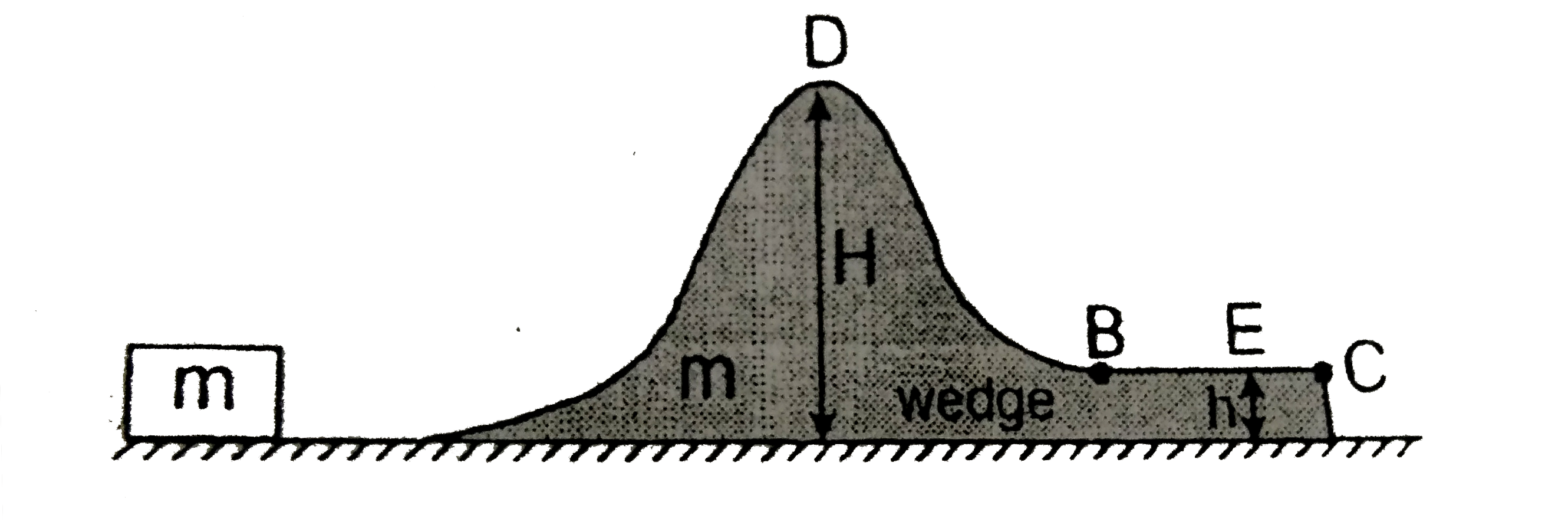
Figure shows an irregular wedge of mass ...

Figure shows an irregular wedge of mass `m` placed on a smooth horizontal surface. Part `BC` is rough.
What minimum velocity should be imparted to a small block of same mass `m` so that it may each point `B` :

Promotional Banner

Similar Questions

Explore conceptually related problems

Figure shows an irregular wedge of mass m placed on a smooth horizontal surface. Part BC is rough. The magnitude of velocity of wedge when the block comes to rest (w.r.t. wedge ) on part BC is :

Figure shows an irregular wedge of mass m placed on a smooth horizontal surface. Part BC is rough. If the coefficient of friction between the block and wedge is mu , and the block comes to rest with respect to wedge at a point E on the rough surface then BE will be

For the system shown in the figure, a small block of mass m and smooth irregular shaped block of mass M , both free to move are placed on a smooth horizontal plane. The minimum velocity v imparted to block so that it will overcome the highest point of M is

For the system shown in the figure, a small block of mass m and smooth irregular shaped block of mass M , both free to move are placed on a smooth horizontal plane. The minimum velocity v imparted to block so that it will overcome the highest point of M is

A block of mass m is placed at rest on a smooth wedge of mass M placed at rest on a smooth horizontal surface. As the system is released

A block of mass m is placed at rest on a smooth wedge of mass M placed at rest on a smooth horizontal surface. As the system is released

A horizontal force F pushes wedge of mass M on a smooth horizontal surface. A block of mass m is stationary to the wedge, then:

A block of mass m is placed on a rough horizontal surface. If minimum force to pull the block is (mg)/(2) then coefficient of friction is :

A block of mass m is placed on the rough incline of a wedge of mass M and inclination alpha to the horizontal. Calculate the maximum and minimum acceleration that can be imparted to the wedge so that the block may remain stationary relative to the wedge. The coefficient iof friction between the block and the wedge is mu .

A block of mass M is kept on a smooth horizontal surface. Another block of mass m, moving with velocity v, collides with it and coalesces. What is the resultant velocity of the system?