

Home
Class 11
PHYSICS
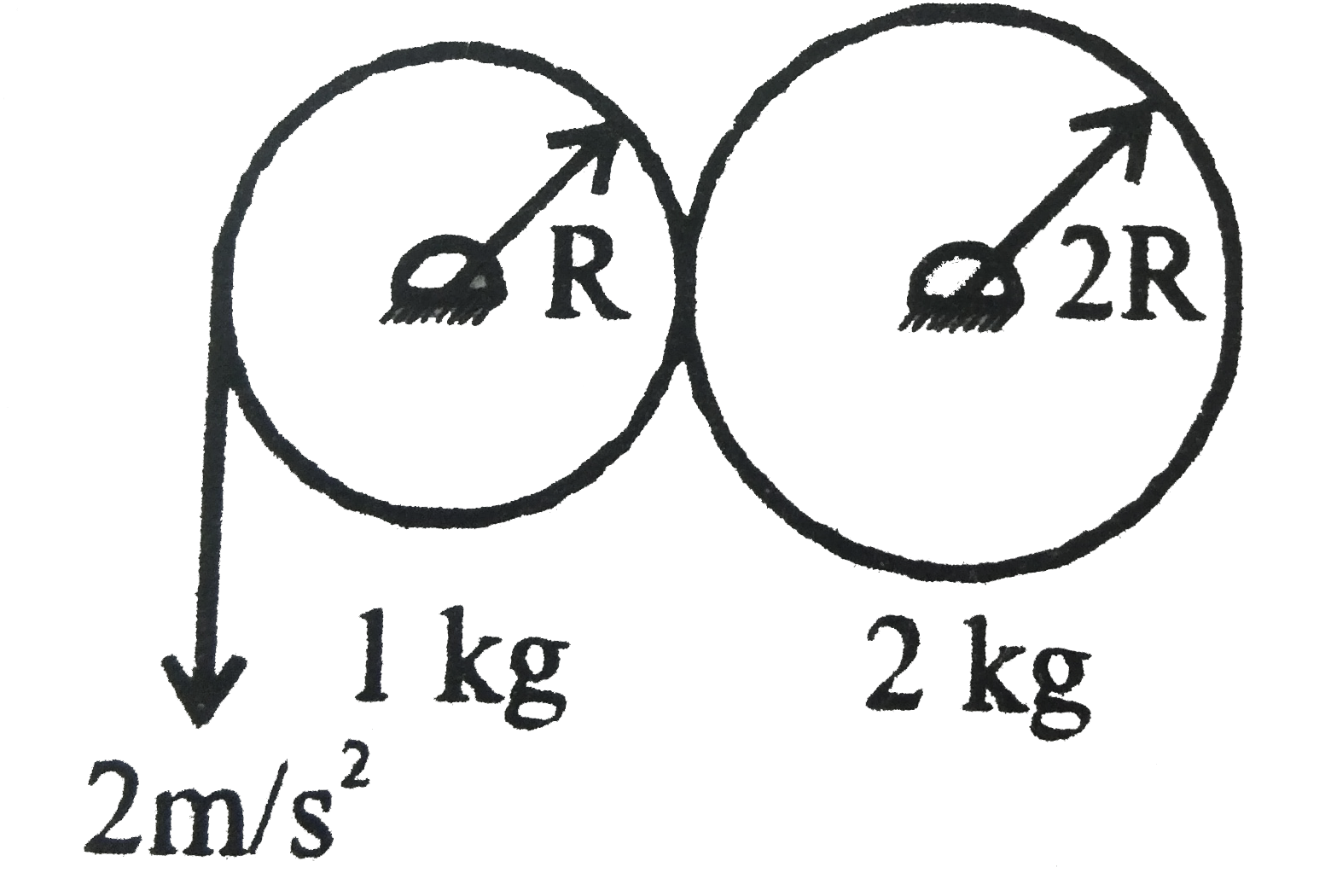
Two discs A and B touch each other as in...

Two discs `A` and `B` touch each other as in figure. A rope tightly wound on `A` is pulled down at `2m//s^(2)`. Find the friction force between `A` and `B` if slipping is absent.
.

Promotional Banner

Similar Questions

Explore conceptually related problems

In the figure shown, the force of friction between A and B will be :

In the figure shown, the force of friction between A and B will be :

A uniform solid. cylinder A of mass can freely rotate about a horizontal axis fixed to a mount of mass m_(2) . A constant horizontal force F is applied to the end K of a light thread tightly wound on the cylinder. The friction between the mount and the supporting horizontal plane is assumed to be absent. Find the acceleration of the point K .

A uniform solid. cylinder A of mass can freely rotate about a horizontal axis fixed to a mount of mass m_(2) . A constant horizontal force F is applied to the end K of a light thread tightly wound on the cylinder. The friction between the mount and the supporting horizontal plane is assumed to be absent. Find the acceleration of the point K .

A uniform solid cylinder A of mass m_1 can freely rotate about a horizontal axis fixed to a mount B of mass m_2 (figure). A constant horizontal force F is applied to the end K of a light thread tightly wound on the cylinder. The friction between the mount and the supporting horizontal plane is assumed to be absent. Find: (a) the acceleration of the point K, (b) the kinetic energy of this system t seconds after the beginning of motion.

Two circles of radii a and b touch each other externally and theta be the angle between their direct common tangents (a>b>=2) then

A thread is wound around two discs on either sides. The pulley and the two discs have the same mass and radius. There is no slipping at the pulley and no friction at the hinge. Find out the acceleration of the two discs and the angular acceleration of the pulley.

A thread is wound around two discs on either sides. The pulley and the two discs have the same mass and radius. There is no slipping at the pulley and no friction at the hinge. Find out the acceleration of the two discs and the angular acceleration of the pulley.

A block A of mass M rests on a wedge B of mass 2M and inclination theta . There is sufficient friction between A and B so that A does not slip on B. If there is no friction between B and ground, the compression in spring is