

Home
Class 11
PHYSICS
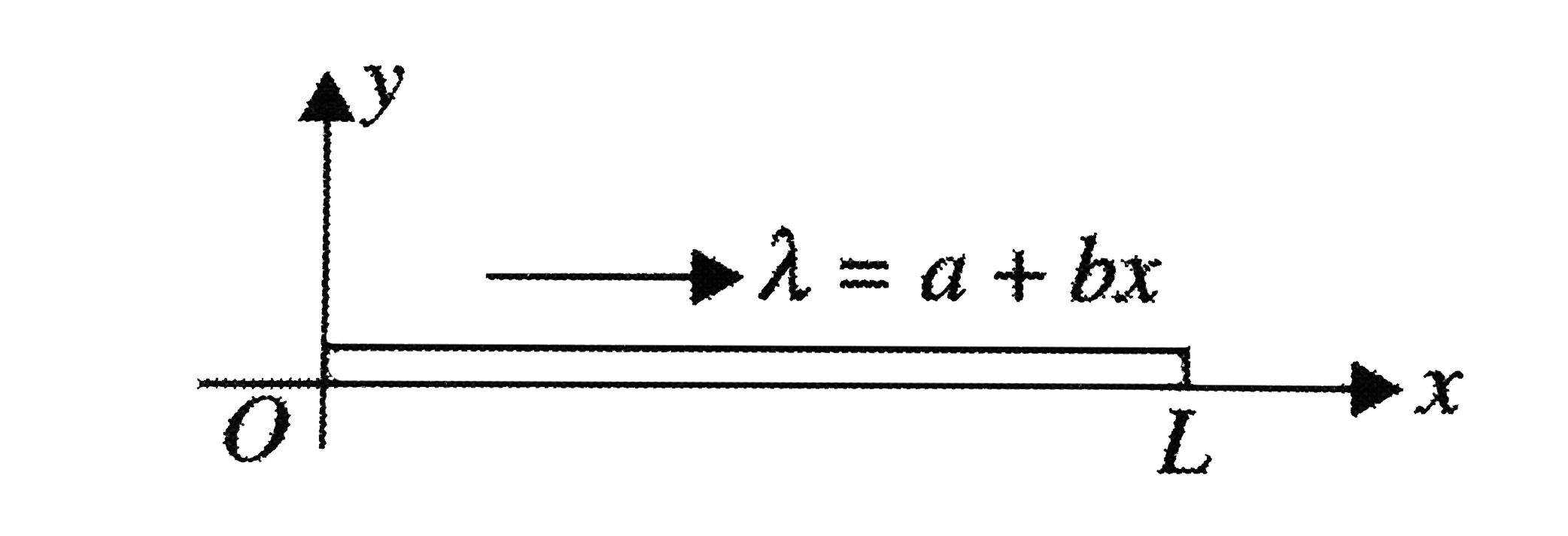
You are given a rod of length L. The lin...

You are given a rod of length L. The linear mass density is `lambda` such that `lambda=a+bx`. Here a and b are constants and the mass of the rod increases as x decreases. Find the mass of the rod

Promotional Banner

Similar Questions

Explore conceptually related problems

A rod of length L is placed along the x-axis between x=0 and x=L. The linear mass density is lambda such that lambda=a+bx . Find the mass of the rod.

Find coordinates of mass center of a non-uniform rod of length L whose linear mass density lambda varies as lambda=a+bx, where x is the distance from the lighter end.

Find coordinates of mass center of a non-uniform rod of length L whose linear mass density lambda varies as lambda=a+bx, where x is the distance from the lighter end.

Find coordinates of mass center of a non-uniform rod of length L whose linear mass density lambda varies as lambda=a+bx, where x is the distance from the lighter end.

A rod of length L is placed along the x-axis between x=0 and x=L . The linear mass density (mass/length) rho of the rod varies with the distance x from the origin as rho=a+bx . Here, a and b are constants. Find the position of centre of mass of this rod.

A rod of length L is placed along the x-axis between x=0 and x=L . The linear mass density (mass/length) rho of the rod varies with the distance x from the origin as rho=a+bx . Here, a and b are constants. Find the position of centre of mass of this rod.

The linear mass density lambda of a rod AB is given by lambda =aplha+betaxkg/m taking O as origin. Find the location of the centre of mass from the end A?

The linear density of a non - uniform rod of length 2m is given by lamda(x)=a(1+bx^(2)) where a and b are constants and 0lt=xlt=2 . The centre of mass of the rod will be at. X=

The linear density of a non - uniform rod of length 2m is given by lamda(x)=a(1+bx^(2)) where a and b are constants and 0lt=xlt=2 . The centre of mass of the rod will be at. X=