

Home
Class 12
PHYSICS
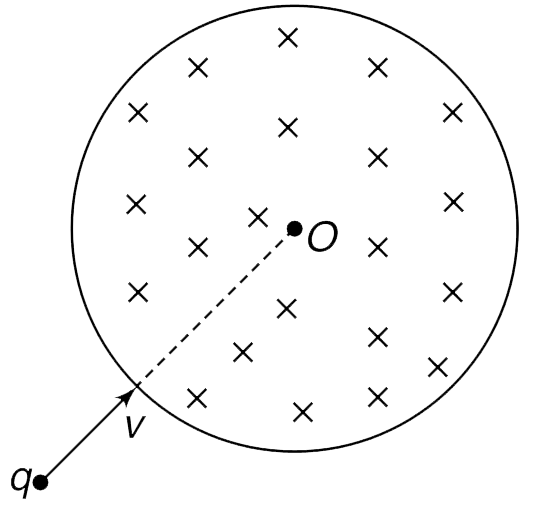
Figure shows a circular region of radius...

Figure shows a circular region of radius `R-sqrt3m` which has a uniform magnetic field `B=0.2T `directed into the plane of the figure. A particle having mass `m =2g,` speed `v = 0.3 m//s ` and charge `q = 1 mC` is projected along the radius of the circular region as shown in figure. Calculate the angular deviation produced in the path of the particle as it comes out of the magnetic field. Neglect any other force apart from the magnetic force.

Promotional Banner

Similar Questions

Explore conceptually related problems

Figure shown circular region of radius R = sqrt(3)m in which upper half has uniform magnetic field vec(B)=0.2(-hat(K))T and lower half has uniform magnitic field vec(B)=0.2hat(K)T . A very thin parallel beam of point charges each having mass m = 2gm, speed v = 0.3m//sec and charge q= +1mC are projected along the diameter as shown in figure. A screen is placed perpendicular to initial velocity of charges as shown. If the distance between the point on screen where charges will strike is 4X meters, then calculate X.

A particle of mass m and charge q is projected into a region having a perpendicular magnetic field B. Find the angle of deviation of the particle as it comes out of the magnetic field if ihe width d of the region is (2mv)/(qB)

A particle of mass m and charge q is projected into a region having a perpendicular magnetic field B. Find the angle of deviation fo the particle as it comes out of the magnetic field if the width d of the regions is very smaller then

A particle of mass m and charge q is projected into a region having a perpendicular magnetic field B. Find the angle of deviation fo the particle as it comes out of the magnetic field if the width d of the regions is very smaller then

A particle having mass m and charge q is projected with a velocity v making an angle q with the direction of a uniform magnetic field B. Calculate the magnitude of change in velocity of the particle after time t=(pim)/(2qB) .

A particle of mass m and charge q is projected into a region having a perpendicular magnetic, field B . Find the angle of deviation of the particle as it comes out of the magnetic field if th,, width of the region is (b) (a) (2mv)/(Bq) (b) (mv)/(Bq) (c) (mv)/(2 Bq)

There exist uniform magnetic field vec(B)=-B_(0)hatk in region of space with 0ltxltd and 2dltxlt3d as shown in the figure. A positive charged particle of mass m and charge q is projected with velocity vec(v)=vhat(i) as shown in the figure. If radius of curvature of path of the charged particle in magnetic field is R(2dltRlt3d) then time elapse by charged particle in magnetic field regions is

There exist uniform magnetic field vec(B)=-B_(0)hatk in region of space with 0ltxltd and 2dltxlt3d as shown in the figure. A positive charged particle of mass m and charge q is projected with velocity vec(v)=vhat(i) as shown in the figure. If radius of curvature of path of the charged particle in magnetic field is R(2dltRlt3d) then time elapse by charged particle in magnetic field regions is

There exist uniform magnetic field vec(B)=-B_(0)hatk in region of space with 0ltxltd and 2dltxlt3d as shown in the figure. A positive charged particle of mass m and charge q is projected with velocity vec(v)=vhat(i) as shown in the figure. If radius of curvature of path of the charged particle in magnetic field is R(2dltRlt3d) then time elapse by charged particle in magnetic field regions is