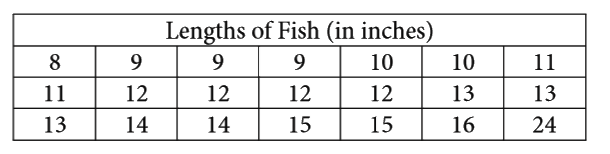
The table above lists the lengths, to the nearest inch, of a random sample of 21 brown bullhead fish. The outlier measurement of 24 inches is an error. Of the mean, median, and range of the values listed, which will change the most if the 24-inch measurement is removed from the data?
The table above lists the lengths, to the nearest inch, of a random sample of 21 brown bullhead fish. The outlier measurement of 24 inches is an error. Of the mean, median, and range of the values listed, which will change the most if the 24-inch measurement is removed from the data?



Similar Questions
Explore conceptually related problems
A wedge shaped piece is cut from a circular pizza. The radius of the pizza is 14 inches and the angle of the pointed end of the pizza measures 0.35 radians. The number of inches in the length of the rounded edge of the crust is closest to which values?
The rupee, which is currently the worst-performing currency in Asia, is finally receiving some help from the authorities. The Union government, after a meeting with Reserve Bank of lndia Governor, announced a list of measures to (A) the sharp declme in the currency, which has lost about 12% of its value since the beginning of the year. (B) These include steps to curb the import of non-essential goods and encourage the export of domestic goods, which will help in addressing the country's burgeoning current account deficit that hit a five-year high in July. (C) Other steps such as removing restrictions on foreign portfolio investments and encouraging (1) Indian borrowers to facilitate (2) rupee-denominated 'masala bonds' were also announced (3) to issue (4) the inflow of dollars and de-risk the economy from fluctuations in the exchange rate. Further, the term limit imposed on borrowings of manufacturing companies is to be shortened further (D) _____ . The response to the move from the markets will need to be carefully tracked. Even before the official announcement on Friday, the rupee witnessed some recovery against the dollar (E) hopes of favourable government intervention, while stocks and bonds also recovered. These steps to strengthen the rupee in the short term are welcome, given the large-scale outflow of capital from emerging markets to the West. These ad hoc steps to avoid an immediate (F) crisis in the external sector, however, should not deflect attention from the more fundamental reasons behind the decline of the rupee. India has been unable to boost exports over the years for various reasons. (G) This has meant that the rise in the price of oil has traditionally exerted tremendous stress on the current account deficit and the currency, as is happening now. (H) The government needs to think of a long-term plan ( 1) to boost (2) exports, preferably through growth (3) that remove policy barriers that are impeding the steps (4) of export-oriented sectors, in order to find a sustainable solution to the problem of the weakening rupee. The depreciating rupee is also a symptom of persistently higher domestic inflation in India over many decades. For example, in line with vastly different inflation rates in India and the U.S., the rupee has lost about 60% of its value in the last 10 years against the dollar. (I) So this problem cannot be addressed without drastic changes in the style in monetary policy conducted by the RBI, which is an unlikely proposition. Until then, the best that can be (J) __ for is a steady drop in the value of the rupee without any drastic shocks to the economy. Which of the following words given in the option should come at the place marked as (A) in the above paragraph to make it grammatically correct and meaningful. Also, the word should fill in the two sentences given below to make them contextually correct and meaningful. (i) The king built a great temple, a hippodrome and a street of columns surrounding the city, the remains of which still the attention. (ii) His had caused great indignation.
The rupee, which is currently the worst-performing currency in Asia, is finally receiving some help from the authorities. The Union government, after a meeting with Reserve Bank of lndia Governor, announced a list of measures to (A) the sharp declme in the currency, which has lost about 12% of its value since the beginning of the year. (B) These include steps to curb the import of non-essential goods and encourage the export of domestic goods, which will help in addressing the country's burgeoning current account deficit that hit a five-year high in July. (C) Other steps such as removing restrictions on foreign portfolio investments and encouraging (1) Indian borrowers to facilitate (2) rupee-denominated 'masala bonds' were also announced (3) to issue (4) the inflow of dollars and de-risk the economy from fluctuations in the exchange rate. Further, the term limit imposed on borrowings of manufacturing companies is to be shortened further (D) _____ . The response to the move from the markets will need to be carefully tracked. Even before the official announcement on Friday, the rupee witnessed some recovery against the dollar (E) hopes of favourable government intervention, while stocks and bonds also recovered. These steps to strengthen the rupee in the short term are welcome, given the large-scale outflow of capital from emerging markets to the West. These ad hoc steps to avoid an immediate (F) crisis in the external sector, however, should not deflect attention from the more fundamental reasons behind the decline of the rupee. India has been unable to boost exports over the years for various reasons. (G) This has meant that the rise in the price of oil has traditionally exerted tremendous stress on the current account deficit and the currency, as is happening now. (H) The government needs to think of a long-term plan ( 1) to boost (2) exports, preferably through growth (3) that remove policy barriers that are impeding the steps (4) of export-oriented sectors, in order to find a sustainable solution to the problem of the weakening rupee. The depreciating rupee is also a symptom of persistently higher domestic inflation in India over many decades. For example, in line with vastly different inflation rates in India and the U.S., the rupee has lost about 60% of its value in the last 10 years against the dollar. (I) So this problem cannot be addressed without drastic changes in the style in monetary policy conducted by the RBI, which is an unlikely proposition. Until then, the best that can be (J) __ for is a steady drop in the value of the rupee without any drastic shocks to the economy. Which of the following words given in the option should come at the place marked as (E) in the above paragraph to make it grammatically correct and meaningful. Also, the word should fill in the two sentences given below to make them contextually correct and meaningful. (i) The cottage is situated on the river bank ___ scenery of surpassing loveliness. (ii) I stood __ the familiar instruments, wondering where to begin.
The rupee, which is currently the worst-performing currency in Asia, is finally receiving some help from the authorities. The Union government, after a meeting with Reserve Bank of lndia Governor, announced a list of measures to (A) the sharp declme in the currency, which has lost about 12% of its value since the beginning of the year. (B) These include steps to curb the import of non-essential goods and encourage the export of domestic goods, which will help in addressing the country's burgeoning current account deficit that hit a five-year high in July. (C) Other steps such as removing restrictions on foreign portfolio investments and encouraging (1) Indian borrowers to facilitate (2) rupee-denominated 'masala bonds' were also announced (3) to issue (4) the inflow of dollars and de-risk the economy from fluctuations in the exchange rate. Further, the term limit imposed on borrowings of manufacturing companies is to be shortened further (D) _____ . The response to the move from the markets will need to be carefully tracked. Even before the official announcement on Friday, the rupee witnessed some recovery against the dollar (E) hopes of favourable government intervention, while stocks and bonds also recovered. These steps to strengthen the rupee in the short term are welcome, given the large-scale outflow of capital from emerging markets to the West. These ad hoc steps to avoid an immediate (F) crisis in the external sector, however, should not deflect attention from the more fundamental reasons behind the decline of the rupee. India has been unable to boost exports over the years for various reasons. (G) This has meant that the rise in the price of oil has traditionally exerted tremendous stress on the current account deficit and the currency, as is happening now. (H) The government needs to think of a long-term plan ( 1) to boost (2) exports, preferably through growth (3) that remove policy barriers that are impeding the steps (4) of export-oriented sectors, in order to find a sustainable solution to the problem of the weakening rupee. The depreciating rupee is also a symptom of persistently higher domestic inflation in India over many decades. For example, in line with vastly different inflation rates in India and the U.S., the rupee has lost about 60% of its value in the last 10 years against the dollar. (I) So this problem cannot be addressed without drastic changes in the style in monetary policy conducted by the RBI, which is an unlikely proposition. Until then, the best that can be (J) __ for is a steady drop in the value of the rupee without any drastic shocks to the economy. In the passage given, a sentence (B) is given in italics, There may or may not be an error in one part of the sentence. Choose the part which has an error in it as your answer. If there is no error then choose option (e) as your answer.
The rupee, which is currently the worst-performing currency in Asia, is finally receiving some help from the authorities. The Union government, after a meeting with Reserve Bank of lndia Governor, announced a list of measures to (A) the sharp declme in the currency, which has lost about 12% of its value since the beginning of the year. (B) These include steps to curb the import of non-essential goods and encourage the export of domestic goods, which will help in addressing the country's burgeoning current account deficit that hit a five-year high in July. (C) Other steps such as removing restrictions on foreign portfolio investments and encouraging (1) Indian borrowers to facilitate (2) rupee-denominated 'masala bonds' were also announced (3) to issue (4) the inflow of dollars and de-risk the economy from fluctuations in the exchange rate. Further, the term limit imposed on borrowings of manufacturing companies is to be shortened further (D) _____ . The response to the move from the markets will need to be carefully tracked. Even before the official announcement on Friday, the rupee witnessed some recovery against the dollar (E) hopes of favourable government intervention, while stocks and bonds also recovered. These steps to strengthen the rupee in the short term are welcome, given the large-scale outflow of capital from emerging markets to the West. These ad hoc steps to avoid an immediate (F) crisis in the external sector, however, should not deflect attention from the more fundamental reasons behind the decline of the rupee. India has been unable to boost exports over the years for various reasons. (G) This has meant that the rise in the price of oil has traditionally exerted tremendous stress on the current account deficit and the currency, as is happening now. (H) The government needs to think of a long-term plan ( 1) to boost (2) exports, preferably through growth (3) that remove policy barriers that are impeding the steps (4) of export-oriented sectors, in order to find a sustainable solution to the problem of the weakening rupee. The depreciating rupee is also a symptom of persistently higher domestic inflation in India over many decades. For example, in line with vastly different inflation rates in India and the U.S., the rupee has lost about 60% of its value in the last 10 years against the dollar. (I) So this problem cannot be addressed without drastic changes in the style in monetary policy conducted by the RBI, which is an unlikely proposition. Until then, the best that can be (J) __ for is a steady drop in the value of the rupee without any drastic shocks to the economy. The sentence given in (C) has four words printed in bold. Amongst the given bold words, which of the followmg must replace each other to make the sentence contextually correct and meaningful?
The rupee, which is currently the worst-performing currency in Asia, is finally receiving some help from the authorities. The Union government, after a meeting with Reserve Bank of lndia Governor, announced a list of measures to (A) the sharp declme in the currency, which has lost about 12% of its value since the beginning of the year. (B) These include steps to curb the import of non-essential goods and encourage the export of domestic goods, which will help in addressing the country's burgeoning current account deficit that hit a five-year high in July. (C) Other steps such as removing restrictions on foreign portfolio investments and encouraging (1) Indian borrowers to facilitate (2) rupee-denominated 'masala bonds' were also announced (3) to issue (4) the inflow of dollars and de-risk the economy from fluctuations in the exchange rate. Further, the term limit imposed on borrowings of manufacturing companies is to be shortened further (D) _____ . The response to the move from the markets will need to be carefully tracked. Even before the official announcement on Friday, the rupee witnessed some recovery against the dollar (E) hopes of favourable government intervention, while stocks and bonds also recovered. These steps to strengthen the rupee in the short term are welcome, given the large-scale outflow of capital from emerging markets to the West. These ad hoc steps to avoid an immediate (F) crisis in the external sector, however, should not deflect attention from the more fundamental reasons behind the decline of the rupee. India has been unable to boost exports over the years for various reasons. (G) This has meant that the rise in the price of oil has traditionally exerted tremendous stress on the current account deficit and the currency, as is happening now. (H) The government needs to think of a long-term plan ( 1) to boost (2) exports, preferably through growth (3) that remove policy barriers that are impeding the steps (4) of export-oriented sectors, in order to find a sustainable solution to the problem of the weakening rupee. The depreciating rupee is also a symptom of persistently higher domestic inflation in India over many decades. For example, in line with vastly different inflation rates in India and the U.S., the rupee has lost about 60% of its value in the last 10 years against the dollar. (I) So this problem cannot be addressed without drastic changes in the style in monetary policy conducted by the RBI, which is an unlikely proposition. Until then, the best that can be (J) __ for is a steady drop in the value of the rupee without any drastic shocks to the economy. The sentence given in (H) has four words printed in bold. Amongst the given bold words, which of the following must replace each other to make the sentence contextually correct and meaningful?
Recommended Questions
- The table above lists the lengths, to the nearest inch, of a random sa...
Text Solution
|
- Match the following lists:
Text Solution
|
- How many lines of symmetry does the above figure have ? <img src="http...
Text Solution
|
- Which of the following are correct chain isomers of butane ? (i) <img ...
Text Solution
|
- Determine the point of symmetry of a regular hexagon. <img src="htt...
Text Solution
|
- Match the following Column A to Column B
Text Solution
|
- Match the following Column A to Column B
Text Solution
|
- Match the following Column A to Column B
Text Solution
|
- The inequation represented by the graph given below is : <img src="htt...
Text Solution
|