

Home
Class 12
PHYSICS
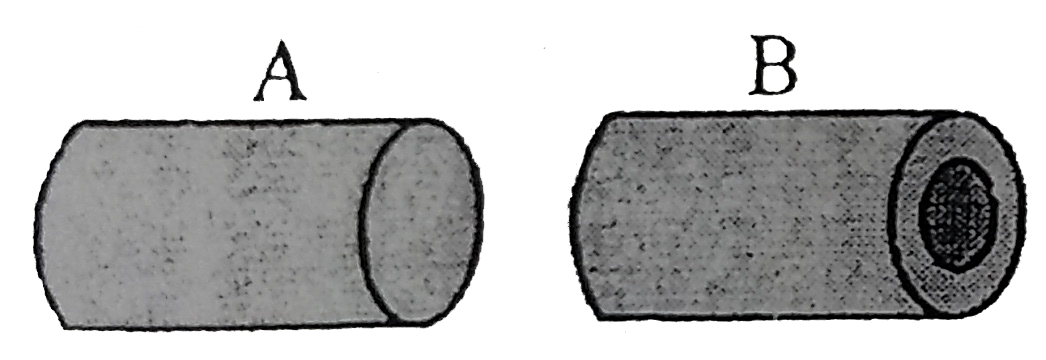
The drawing shows two cylinders. They ar...

The drawing shows two cylinders. They are identicle in all respects, except one is hollow. In a setup like that in figure identical forces are applied to the right end of each cylinder while the left end is fixed.

Promotional Banner

Similar Questions

Explore conceptually related problems

A cylinder of mass m suspended by two strings wrapped around the cylinder one near each end, the free ends of the string being attached to hooks on the ceiling, such that the length of the cylinder is horizontal. From the position of rest , the cylinder is allowed to roll down as suspension strings unwind , calculate (a) The downward linear acceleration of the cylinder (b) The tension in the strings (c) The time dependence of the instantaneous power developed by gravity

A horizontal uniform rod of mass 'm' has its left end hinged to the fixed incline plane, while its right end rrests on the top of a uniform cylinder of mass 'm' which in turn is at rest on the fixed inclined plane as shown. The coefficient of friction between the cylinder and rod, and between the cylinder and inclined plane, is sufficient to keep the cylinder at rest. The ratio of magnitude of frictional force on the cylinder due to the rod and the magnitude of frictional force on the cylinder due to the inclined plane is :

A horizontal uniform rod of mass 'm' has its left end hinged to the fixed incline plane, while its right end rrests on the top of a uniform cylinder of mass 'm' which in turn is at rest on the fixed inclined plane as shown. The coefficient of friction between the cylinder and rod, and between the cylinder and inclined plane, is sufficient to keep the cylinder at rest. The ratio of magnitude of frictional force on the cylinder due to the rod and the magnitude of frictional force on the cylinder due to the inclined plane is :

A uniform solid cylinder of mass m rests on two horizontal planks. A thread is wound on the cylinder. The hanging end of the thread is pulled vertically down with a constant force F . Find the maximum magnitude of the force F which may be applied without bringing about any sliding of the cylinder, if the coefficient of friction between the plank and the cylinder is equal to mu . What is the maximum acceleration of the centre of mass over the planks?

A uniform solid cylinder of mass m rests on two horizontal planks. A thread is wound on the cylinder. The hanging end of the thread is pulled vertically down with a constant force F . Find the maximum magnitude of the force F which may be applied without bringing about any sliding of the cylinder, if the coefficient of friction between the plank and the cylinder is equal to mu . What is the maximum acceleration of the centre of mass over the planks?

Two metallic cylinder made of same material and radii r and 2r are joined as shown in figure. If top end is ved and lower end of cylinder B is twisted by angle e, then angle of twist for cylinder A is (both cylinder have fixed and

Figure a) shows a spring of force constant k clamped rigidly at once end and a mass m attached to its free end. A force F applied at the free end stretches the spring. Figure b) shows the same spring with both ends free and attached to a mass m at either end. Each end of the spring in figure is stretched by the same force F. (a) What is the maximum extension of the spring in the two cases ? (b) If the mass in figure and the two masses in figure are released free, what is the period of oscillation in each case?

Figure a) shows a spring of force constant k clamped rigidly at once end and a mass m attached to its free end. A force F applied at the free end stretches the spring. Figure b) shows the same spring with both ends free and attached to a mass m at either end. Each end of the spring in figure is stretched by the same force F. (a) What is the maximum extension of the spring in the two cases ? (b) If the mass in figure and the two masses in figure are released free, what is the period of oscillation in each case?

In an experiment , setup A consists of two parallel wires which carry currents in opposite directions as shown in the figure. A second setup B is identical to setup A, except that there is a metal plate between the wires Let F_(A) and F_(B) be the magnitude of the force between the two wires in setup A and setup B, respectively.