

Home
Class 11
PHYSICS
A vertical spring of force cosntant 100 ...

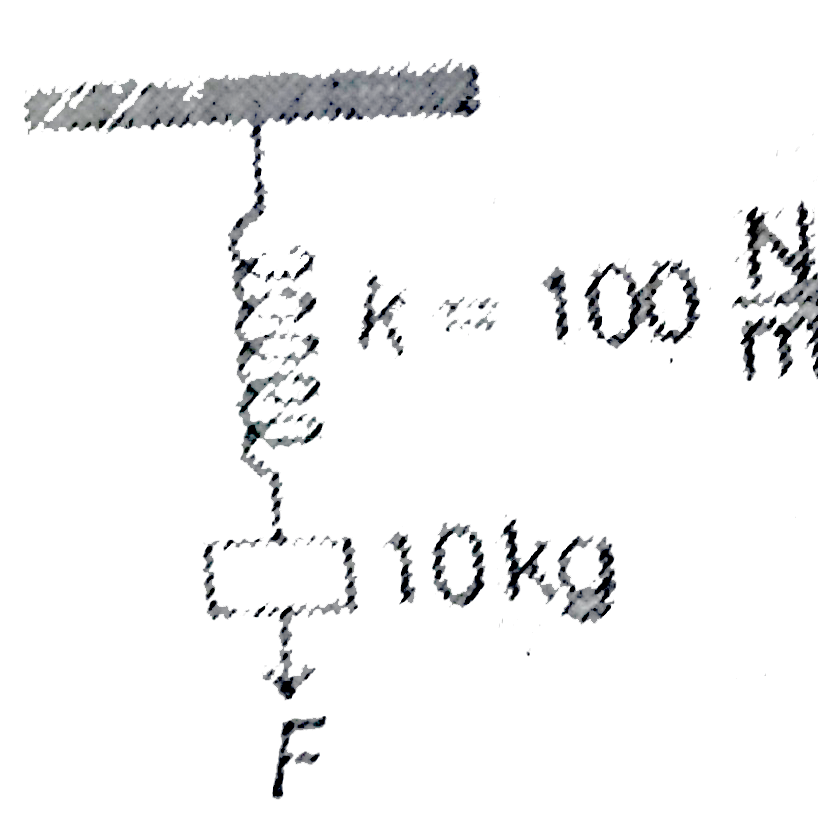
A vertical spring of force cosntant `100 N//m` is attached with a hanging mass of 10 kg. Now an external force is applied on the mass so that the spring is stretched by additional 2m. The work done by the force F is `(g = 10 m//s^(2))`

Promotional Banner

Similar Questions

Explore conceptually related problems

In spring constant of the spring is 100 N//m Extension produced in the spring is: (g=10 m//s^(2))

Certain force acting on a 20 kg mass changes its velocity from 5m//s to 2m//s . calculate the work done by the force.

Certain force acting on a 20 kg mass changes its velocity from 5m//s to 2m//s . calculate the work done by the force.

A toy used for firing a ball vertically consists of a vertical spring which is compressed by 0.1 m by u"sin"g a force of 10 N. A ball of mass 0.050 kg is placed on the compressed spring and the spring is released. The ball will reach a height of ( Use g=10 m//s^(2))

A vertical spring carries a 5kg body and is hanging in equilibrium an additional force is applied so that the spring is further stretched. When released from this position. It performs 50 complete oscillation in 25 s, with an amplitude of 5 cm. The additional force applied is

A vertical spring carries a 5kg body and is hanging in equilibrium an additional force is applied so that the spring is further stretched. When released from this position. It performs 50 complete oscillation in 25 s, with an amplitude of 5 cm. The additional force applied is

Figure a) shows a spring of force constant k clamped rigidly at once end and a mass m attached to its free end. A force F applied at the free end stretches the spring. Figure b) shows the same spring with both ends free and attached to a mass m at either end. Each end of the spring in figure is stretched by the same force F. (a) What is the maximum extension of the spring in the two cases ? (b) If the mass in figure and the two masses in figure are released free, what is the period of oscillation in each case?

Figure a) shows a spring of force constant k clamped rigidly at once end and a mass m attached to its free end. A force F applied at the free end stretches the spring. Figure b) shows the same spring with both ends free and attached to a mass m at either end. Each end of the spring in figure is stretched by the same force F. (a) What is the maximum extension of the spring in the two cases ? (b) If the mass in figure and the two masses in figure are released free, what is the period of oscillation in each case?