

Home
Class 12
PHYSICS
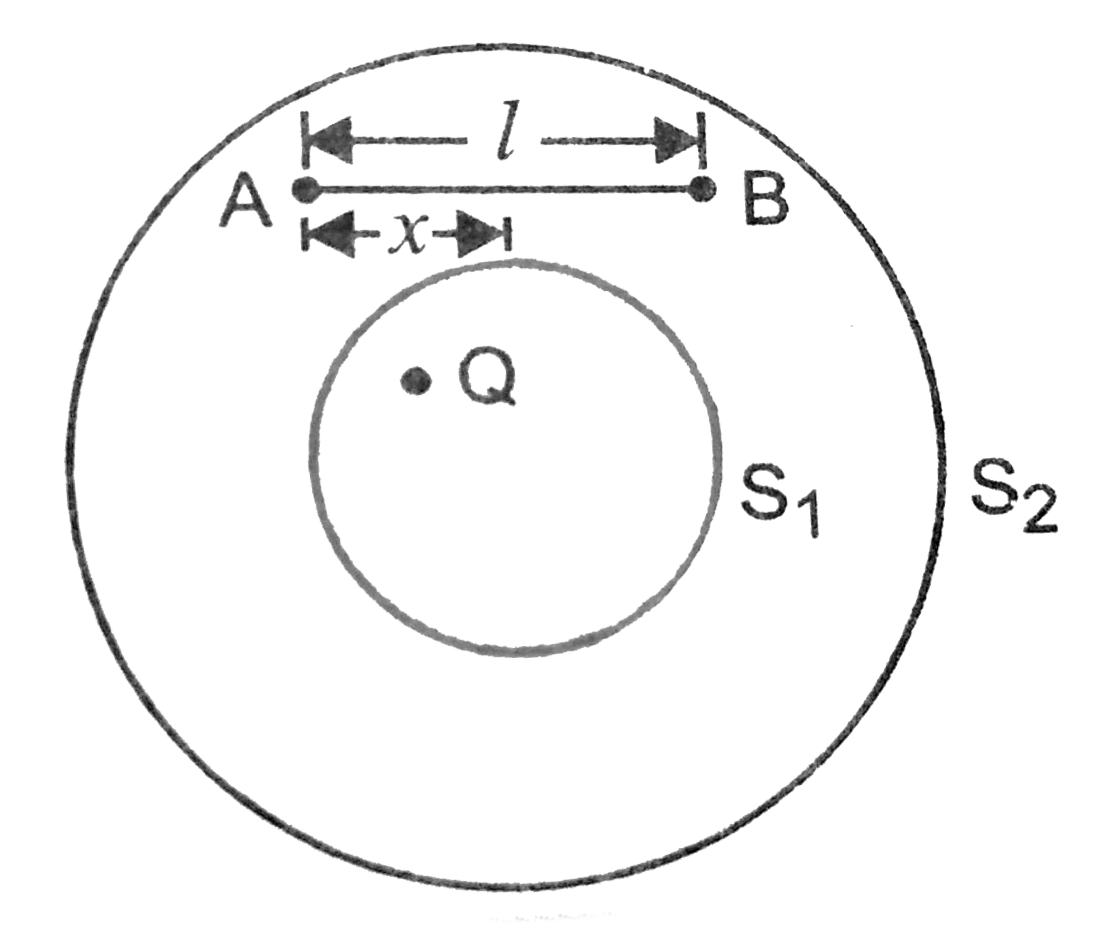
IN fig, calculate the total flux of the ...

IN fig, calculate the total flux of the electrostatic field through the spheres `S_(1) and S_(2)`. The wire AB shown here has a linear charge density `lambda` . Given by `lambda = kx`, where x is the distance measured along the wire from end A.

Promotional Banner

Similar Questions

Explore conceptually related problems

In the given figure, calculate the total flux of the electrostatic field through the sphere S_1 and S_2 . The wire AB, as shown here, has a linear charge density lambda given by lambda = kx , where x is the distance measured along the wire, from the end A.

In the given arrangement find the electric field at C in the figure. Here the U-shaped wire is uniformly charged with linear charge density lambda . [0]

Intensity of electric field at a point at a perpendicular distance .r. from an infinite line charge, having linear charge density .lambda. is given by :

Answer the following: (a) State Gauss' law. Using this law, obtain the expression for the electric field due to an infinitely long straight conductor of linear charge density lamda . (b) A wire AB of length L has linear charge density lamda = kx , where x is measured from the end A of the wire. This wire is enclosed by a Gaussian hollow surface. Find the expression for the electric flux through this surface.

(a) State Gauss's law. Using this law, obtain the expression for the electric field due to an infinitely long straight conductor of linear charge desntiy lamda . (b) A wire AB of length L has linear charge density lamda = kx , where x is measured from the end A of the wire. This wire is enclosed by a Gaussian hollow surface. Find the expression for the electric flux through this surface.

A charge particle q is released at a distance R_(@) from the infinite long wire of linear charge density lambda . Then velocity will be proportional to (At distance R from the wire)

A charge particle q is released at a distance R_(@) from the infinite long wire of linear charge density lambda . Then velocity will be proportional to (At distance R from the wire)

Obtain the formula for the electric field due to a long thin wire of uniform linear charge density lambda without using Gauss’s law.