

Home
Class 12
PHYSICS
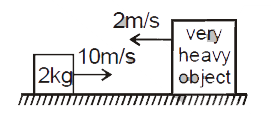
A block of mass 2 kg is pushed towards a...

A block of mass 2 kg is pushed towards a very heavy object moving with 2 m/s closer to the block (as shown). Assuming elastic collision and frictionless surface, find the final velocities of the blocks.

Promotional Banner

Similar Questions

Explore conceptually related problems

A block of mas m is placed on a triangular block of mas m, which in tunis placed on a horizontal surface as shown in figure. Assuming frictionless surfaces find the velocity of the triangular block when the smaller block reaches the bottom end.

A block of mas m is placed on a triangular block of mas m, which in tunis placed on a horizontal surface as shown in figure. Assuming frictionless surfaces find the velocity of the triangular block when the smaller block reaches the bottom end.

A block of mass 1 kg is pushed towards another block of mass 2 kg from 6 m distance as shown in figure. Just after colision velocity of 2 kg block becomes 4 m//s .

A block of mass m moving at a velocity upsilon collides head on with another block of mass 2m at rest. If the coefficient of restitution is 1/2, find the velocities of the blocks after the collision.

A ball is moving with velocity 2m//s towards a heavy wall moving towards the ball with speed 1m//s as shown in figure. Assuming collision to be elastic, find the velocity of ball immediately after the collision.

A ball is moving with velocity 2m//s towards a heavy wall moving towards the ball with speed 1m//s as shown in figure. Assuming collision to be elastic, find the velocity of ball immediately after the collision.

A ball is moving with velocity 2m//s towards a heavy wall moving towards the ball with speed 1m//s as shown in figure. Assuming collision to be elastic, find the velocity of ball immediately after the collision.

A bullte weighing 5 g and moving with a velocity 600 m//s strikes a 5 kg block of ice resting on a frictionless surface. The speed of the block after the collision is

A block of mass 1 kg is pushed towards another block of mass 2 kg from a 6 m distance as shown in the figure. If just after the collision, the velocity of 2 kg block is 4ms^(-1) , then