

Home
Class 12
MATHS
Halle is bowling a series of 3 games. Sh...

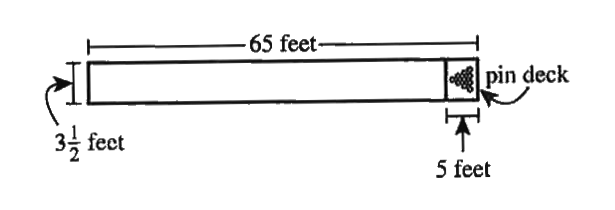
Halle is bowling a series of 3 games. She has bowled 2 of 3 games with scores of 148 and 176. The figure below is a top view of the bowling lane. The dimensions for the bowling lane are given in the figure. The pin deck is the rectangular area within the bowling lane where the bowling pins are set up.
(Note: The figure is not drawn to scale.)

What is the ratio of the total area of the bowling lane to the area of the pin deck?

Promotional Banner

Similar Questions

Explore conceptually related problems

Halle is bowling a series of 3 games. She has bowled 2 of 3 games with scores of 148 and 176. The figure below is a top view of the bowling lane. The dimensions for the bowling lane are given in the figure. The pin deck is the rectangular area within the bowling lane where the bowling pins are set up. (Note: The figure is not drawn to scale.) The diameter of each pin at its base is 2.25 in. When all of the pins are set up, which of the following values is closest to the area, in square inches, that is covered by the bases of the pins?

Halle is bowling a series of 3 games. She has bowled 2 of 3 games with scores of 148 and 176. The figure below is a top view of the bowling lane. The dimensions for the bowling lane are given in the figure. The pin deck is the rectangular area within the bowling lane where the bowling pins are set up. (Note: The figure is not drawn to scale.) What score will Halle need to earn in her 3rd game to have an average score of 172 for the 3 games?

If the coefficient of friction between an insect and bowl is mu and the radius of the bowl is r, find the maximum height to which the insect can crawl in the bowl.

If the coefficient of friction between an insect and bowl is mu and the radius of the bowl is r, find the maximum height to which the insect can crawl in the bowl.

If the coefficient of friction between an insect and bowl is mu and the radius of the bowl is r, find the maximum height to which the insect can crawl in the bowl.

If the coefficient of friction between an insect and bowl is mu and the radius of the bowl is r, find the maximum height to which the insect can crawl in the bowl.

A hemispherical bowl is made up of stone whose thickness is 5 cm. If the inner radius is 35 cm, find the total surface area of the bowl.

A hemispherical bowl is made up of stone whose thickness is 5 cm. If the inner radius is 35 cm, find the total surface area of the bowl.

A hemispherical bowl is made up of stone whose thickness is 5 cm. If the inner radius is 35 cm, find the total surface area of the bowl.

A hemispherical bowl is made up of stone whose thickness is 5 cm. If the inner radius is 35 cm, find the total surface area of the bowl.