

Home
Class 12
PHYSICS
Electric field given by the vector vecE=...

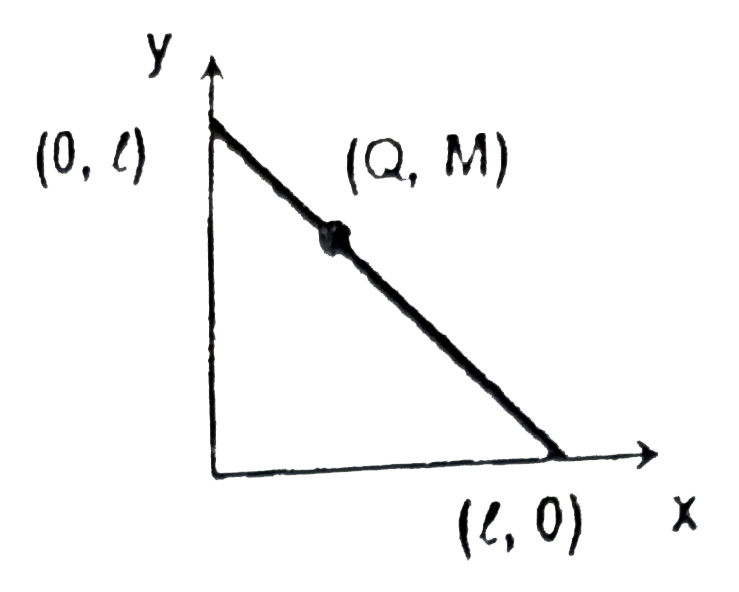
Electric field given by the vector `vecE=(E_(0))/(l)(xhati+yhatj)` N/C is present in the `x-y` plane. A small ring of mass `M` carrying charge `+Q`, which can slide freely on a smooth non conducting rod, is projected along the rod from the point `(0,l)` such that it can reach the other end of the rod. Assuming there is no gravity in the region. What minimum velocity should be given to the ring? if in `S.I.` unit `(QE_(0)l)/(M)=8`

Promotional Banner

Similar Questions

Explore conceptually related problems

Electric field given by the vector vec E = x hat i + y hat j is present in the x y plane. A small ring carrying +Q , which can freely slide on a smooth nonconducting rod, is projected along the rod from the point (0, L) such that it can reach the other end of the rod. What minimum velocity should be given to the ring ? (Assume zero gravity). .

A ball of mass m is attached to one end of a light rod of length l , the other end of which is hinged. What minimum velocity v should be imparted to the ball downwards, so that it can complete the circle ?

A ball of mass m is attached to one end of a light rod of length l , the other end of which is hinged. What minimum velocity v should be imparted to the ball downwards, so that it can complete the circle ?

A homogenous rod XY of length L and mass 'M' is pivoted at the centre 'C' such that it can rotate freely in vertical plane. Initially the rod is in the horizontal position.

A thin non-conducting ring of mass m carrying a charge q can freely rotate about its axis. At t = 0 , the ring was at rest and no magnetic field was present. Then suddenly a magnetic field B was set perpendicular to the plane. Find the angular velocity acquired by the ring.

A thin non-conducting ring of mass m carrying a charge q can freely rotate about its axis. At t = 0 , the ring was at rest and no magnetic field was present. Then suddenly a magnetic field B was set perpendicular to the plane. Find the angular velocity acquired by the ring.

Find the electric field at a point P on the perpendicular bisector of a uniformly charged rod. The length of the rod is L, the charge on it is Q and the distance of P from the centre of the rod is a.