

Home
Class 11
PHYSICS
A metallic hemisphere is having dust on ...

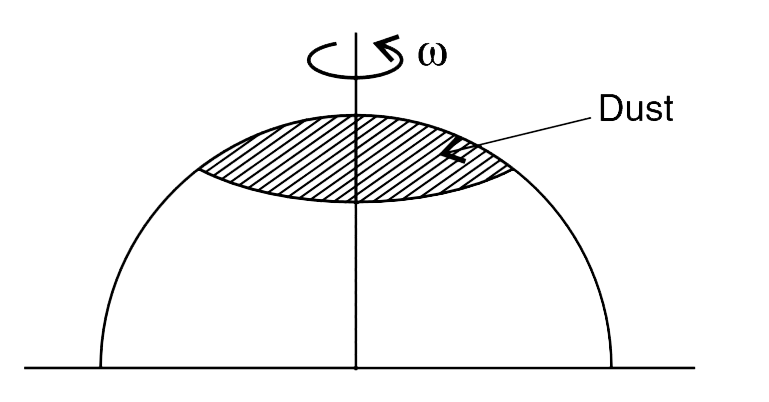
A metallic hemisphere is having dust on its surface. The sphere is rotated about a vertical axis passing through its centre at angular speed `omega = 10 "rad" s^( –1)`. Now the dust is visible only on top `20%` area of the curved hemispherical surface. Radius of the hemisphere is R = 0.1 m. Find the coefficient of friction between the dust particle and the hemisphere [`g = 10 ms^(–2)`].

Promotional Banner

Similar Questions

Explore conceptually related problems

A particle is placed inside a hemispherical bowl which rotates about its vertical axis with constant angular speed omega . It is just prevented from sliding down when the line joining it to the centre of the hemisphere is 45^(@) with the vertical. The radius of the bowl is 10 sqrt(2) m. The coefficient of friction between the particle and the bowl is 0.5 and g = 10 ms^(-2) . Find the magnitude of omega .

A solid sphere of mass 2 kg and radius 1 m is free to rotate about an axis passing through its centre. Find a constant tangential force F required to the sphere with omega = 10 rad/s in 2 s.

A metal disc of radius R can rotate about the vertical axis passing through its centre. The top surface of the disc is uniformly covered with dust particles. The disc is rotated with gradually increasing speed. At what value of the angular speed (omega) of the disc the 75% of the top surface will become dust free. Assume that the coefficient of friction between the dust particles and the metal disc is mu = 0.5 . Assume no interaction amongst the dust particles.

If a solid sphere of mass 1kg and radius 3 cm is rotating about an axis passing through its centre with an angular velocity of 50 rad/s, then the kinetic energy of rotation will be

A metal sphere of radius r and specific heat s is rotated about an axis passing through its centre at a speed of n rotation/s. It is suddenly stopped and 50% of its energy is used in increasing its temperature. Then, the rise in temperature of the sphere is

A metal sphere of radius r and specific heat s is rotated about an axis passing through its centre at a speed of n rotation/s. It is suddenly stopped and 50% of its energy is used in increasing its temperature. Then, the rise in temperature of the sphere is