

Home
Class 12
MATHS
What wind speed would produce the same w...


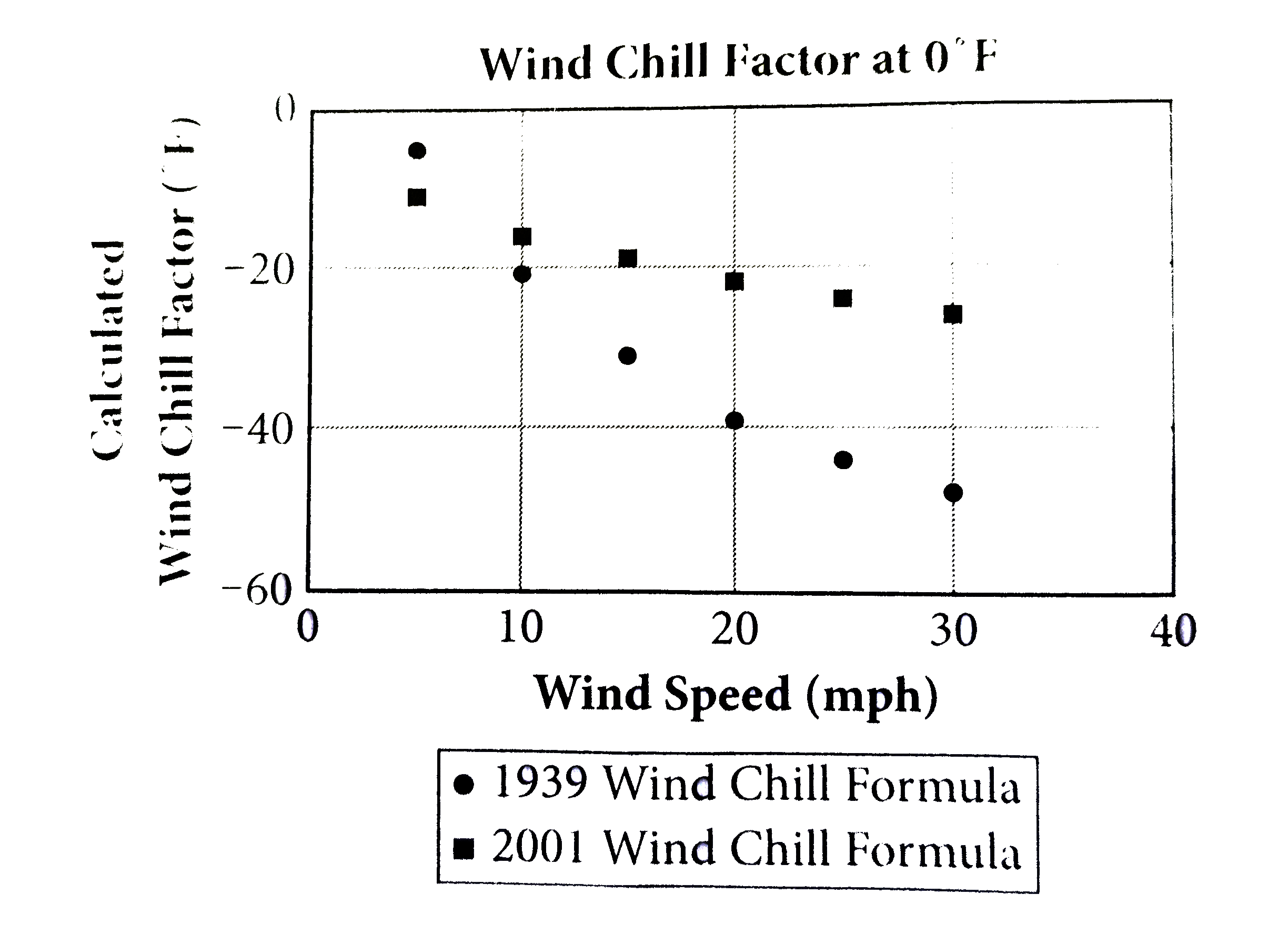
What wind speed would produce the same wind chill using the 1939 ormula as the wind chill produced using the 2001 formula when the outside temperture is `0^(@)F` and the wind speed is 40 miles per hour ?

Promotional Banner

Similar Questions

Explore conceptually related problems

(##KPL_SAT_PRD_PLS_C09_E01_002_Q01.png" width="80%"> Wind chill, a measurement that reflacts the temperature that one feels when outside based on the actual temperature and the wind speed, was first introduced in 1939, and the formula was revised in 2001. If the outside temperature is 0^(@)F, what is the approximate wind chill at 40 miles per hour based on the 2001 formula ?

The instrument used to measure the speed of wind is

The reduction in speed, r,in miles per hour, of an engine having n bogies attached to it is given as : r = 4sqrt(n) . The final spee d , s, in miles per hour , at which the engine can pull then bogies attached is given as: s = 40 - r . What is the speed of the train , to the nearest tenths, in miles per hour, when there are 15 bogies attached ?

A stationary source emits sound of frequency upsilon=1200Hz . If a wind blows at the speed of 0.1c deduce (i) the percentage change in the wavelength and (ii) the change in the frequency for a stationary observer on the wind side of the source. What happens when there is no wind, but the observer moves at speed 0.1c towards the source?

A stationary source emits sound of frequency upsilon=1200Hz . If a wind blows at the speed of 0.1c deduce (i) the percentage change in the wavelength and (ii) the change in the frequency for a stationary observer on the wind side of the source. What happens when there is no wind, but the observer moves at speed 0.1c towards the source?

A stationary source emits sound of frequency upsilon=1200Hz . If a wind blows at the speed of 0.1c deduce (i) the percentage change in the wavelength and (ii) the change in the frequency for a stationary observer on the wind side of the source. What happens when there is no wind, but the observer moves at speed 0.1c towards the source?