

Home
Class 12
PHYSICS
The figure shows the plot of (PV)/(nT) v...

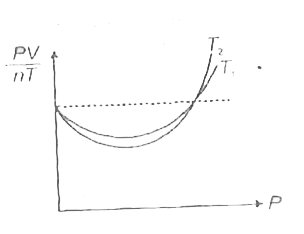
The figure shows the plot of `(PV)/(nT)` vs P, for oxygen gas at two different temperatures then

Promotional Banner

Similar Questions

Explore conceptually related problems

The figure below shows the plot of versus P for oxygen gas at two different temperatures Read the following statements concerning the curves given below i)The dotted line corresponds to the 'ideal' gas behaviour ii) T_(1)gtT_(2) iii)The value of (PV)/(nT) at the point ,where the curves meet on the y-axis is the same for all gases which of the above statement is true?

Figure show plot of (PV)/(T) and P for 2gm of oxygen gas at two different temeratures. (i)The significance of dotted line (ii)The relation between T_(1) and T_(2) (iii)The value of (PV)/(T) where the curves meet on the Y-axis.

Figure 13.8 shows plot of PV//T versus P for l.OOxxlO^-3 kg of oxygen gas at two different temperatures What is the value of PV/Twhere the curves meet on the y-axis? :

Figure 13.8 shows plot of PV//T versus P for l.OOxxlO^-3 kg of oxygen gas at two different temperatures. What does the dotted plot signif?:

Figure 13.8 shows plot of PV//T versus P for l.OOxxlO^-3 kg of oxygen gas at two different temperatures.Which is true: T_1 > T_2 or T_1

Figure shows plot of PV//T versus P"for" 1.00 xx 10^(-3) kg of oxygen gas at two different temperatures. (i) What does the dotted plot signify? (ii) Which is true . T_(1) gt T_(2) "or" T_(1) lt T_(2) ? (iii) What is the value of PV//T where the curves meet on the y-axis?

Figure shows plot of PV//T versus P"for" 1.00 xx 10^(-3) kg of oxygen gas at two different temperatures. (i) What does the dotted plot signify? (ii) Which is true . T_(1) gt T_(2) "or" T_(1) lt T_(2) ? (iii) What is the value of PV//T where the curves meet on the y-axis?

Given is the graph between (PV)/T and P for 1 gm of oxygen gas at two different temperatures T_(1) and T_(2) Fig. Given, density of oxygen = 1.427 kg m^(-3) . The value of (PV)//(T) at the point A and the relation between T_(1) and T_(2) are respectively :