

Home
Class 12
PHYSICS
Two bodies of masses m1 and m2( < m1) a...

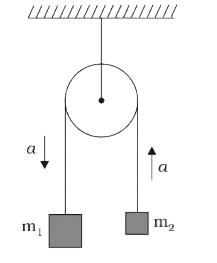
Two bodies of masses `m_1 and m_2( < m_1)` are connected to the ends of a massless cord and allowed to move as shown in figure. The pulley is both massless and frictionless. The acceleration of the centre of mass is `((m_1 - m_2)^n)/((m_1 + m_2)^2) g`. Find the value of n.

Promotional Banner

Similar Questions

Explore conceptually related problems

Two bodies with masses m_1 and m_2 , (m_1>m_2) are joined by a massless string passing over a fixed pulley.The downward acceleration of mass m_1 is :

Two bodies with masses m_1 and m_2(m_1gtm_2) are joined by a string passing over fixed pulley. Assume masses of the pulley and thread negligible. Then the acceleration of the centre of mass of the system (m_1+m_2) is

Two bodies with masses m_1 and m_2(m_1gtm_2) are joined by a string passing over fixed pulley. Assume masses of the pulley and thread negligible. Then the acceleration of the centre of mass of the system (m_1+m_2) is

Two bodies with masses m_1 and m_2 (m_2 gt m) connected by a thread lie on a smooth table. A force Q is first applied to the larger mass and then to the smaller mass. The ratio of tensions in the thread in the two cases will be

Two bodies of mass m_(1) and m_(2) are initially at rest placed infinite distance apart. They are then allowed to move towards each other under mutual gravitational attaction. Show that their relative velocity of approach at separation r betweeen them is v=sqrt(2G(m_(1)+m_(2)))/(r)

Two bodies of mass m_(1) and m_(2) are initially at rest placed infinite distance apart. They are then allowed to move towards each other under mutual gravitational attaction. Show that their relative velocity of approach at separation r betweeen them is v=sqrt(2G(m_(1)+m_(2)))/(r)