

Home
Class 12
PHYSICS
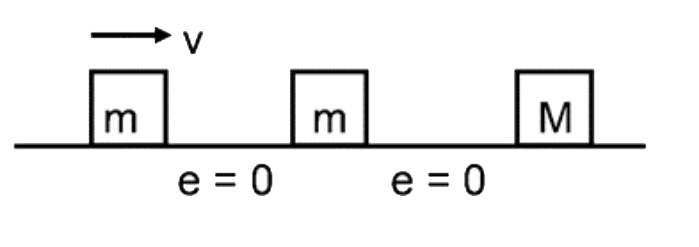
Three blocks of masses m , m and M are k...

Three blocks of masses m , m and M are kept on a frictionless floor as shown in the figure .The leftmost block is given velocity v towards the right . All the collision between the blocks are perfectly inelastic . The loss in kinetic energy after all the collision is `5//6th` of initial kinetic energy. The ratio of `M//m` will be

Promotional Banner

Similar Questions

Explore conceptually related problems

The collision between both blocks shown in figure is completely inelastic. The total energy of oscillation after collision is

There are hundred indentical blocks equally spaced on a frictionless track as shown in the figure . Initially , all the blocks are separate . Each collision is perfectly inelastic . The final velocity will be

There are hundred indentical blocks equally spaced on a frictionless track as shown in the figure . Initially , all the blocks are separate . Each collision is perfectly inelastic . The final velocity will be

Two identical balls, each of mass m , are tied with a string and kept on a frictionless surface. Initially, the string is slack. They are given velocities 2u and u . in the same direction. Collision between the balls is perfectly elastic. After the first collision, what is the total loss in kinetic energy of the balls?

Infinite blocks each of mass M are placed along a straight line with a distance d between each of them. At t = 0 the leftmost block is given a velocity V towards right. The coefficient of frication between any block and the surface is mu and all collisions are elastic. Let the total number of collisions be N then N is

Infinite blocks each of mass M are placed along a straight line with a distance d between each of them. At t = 0 the leftmost block is given a velocity V towards right. The coefficient of frication between any block and the surface is mu and all collisions are elastic. Let the total number of collisions be N then N is

Two blocks of mass m and M are lying on a smooth table. A spring is attached with the block of mass M (see fig). Block of mass m is given a velocity towards the other block. Find the value of (M)/(m) for which the kinetic energy of the system will never fall below one third of the initial kinetic energy imparted to the block of mass m.

A particle of mass m moving in the x direction with speed 2v is hit by particle of mass 2m moving in the y direction with speed v. If the collision is perfectly inelastic, the percentage loss in the energy during the collision is close to: