

Home
Class 12
PHYSICS
A long cylindrical pipe of radius 20 cm ...

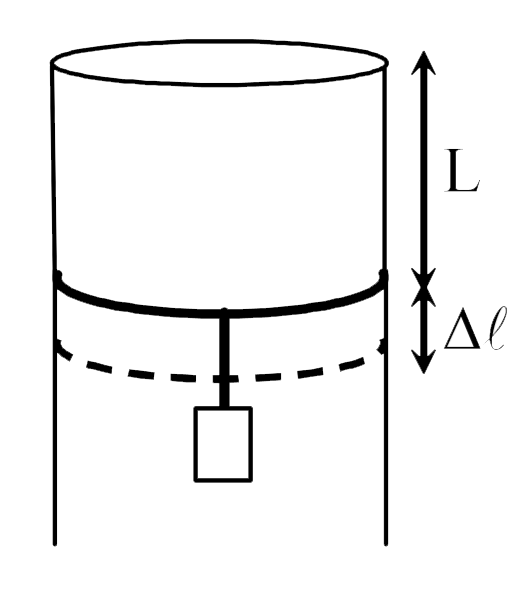
A long cylindrical pipe of radius 20 cm is closed at its upper end and has an airtight piston of negligible mass as shown. When a 50 Kg mass is attached to the other end of the pistion, it moves down by a distance`Deltal` before coming to equilibrium. Assuming air to be an ideal gas, `Deltal//L` (see figure) is close to (g = 10 `ms^(2)` , atmospheric pressure is `10^(5)` Pascal),

Promotional Banner

Similar Questions

Explore conceptually related problems

A long cylindrical pipe of radius 20 cm is closed at its upper end and has an airtight piston of negligible mass as shown. When a 50 Kg mass is attached to the other end of the pistion, it moves down. If the air in the enclosure is cooled from temperature T to T – DeltaT , the piston moves back to its original position. Then DeltaT//T is close to (Assuming air to be an ideal gas, g = 10 m//s^(2) , atmospheric pressure is 10_(5) Pascal),

A cylindrical tube of cross sectional area 20cm^(2) is filled with water to a height of 10cm. The tube carries a tight fitting piston of negligible mass. What will be the pressure exerted at the bottom of the tube when a mass of 2 kg placed on the piston? Atmospheric pressure can be ignored.

A person blows into open- end of a long pipe. As a result,a high pressure pulse of air travel down the pipe. When this pulse reaches the other end of the pipe,

A person blows into open- end of a long pipe. As a result,a high pressure pulse of air travel down the pipe. When this pulse reaches the other end of the pipe,

One end of a cylinderical pipe has a radius of 2 cm. Water comes out at 10 m/s. The rate at which mass is leaving the pipe is

One end of a cylinderical pipe has a radius of 2 cm. Water comes out at 10 m/s. The rate at which mass is leaving the pipe is

A mass of 3 kg is attached at end of rope with 6 kg mass. At upper end of rope tension will be …... .

A cylinderical jar of cross-sectional area of 50 cm^(2) is filled with water to a height of 20cm . It carries a tight fitting piston of negligible mass. Calculate the pressure at the bottom of the jar when a mass of 1 kg is placed on the piston . Ignore atmospheric pressure.