

Home
Class 11
PHYSICS
Two plates each of area A thickness L(1)...

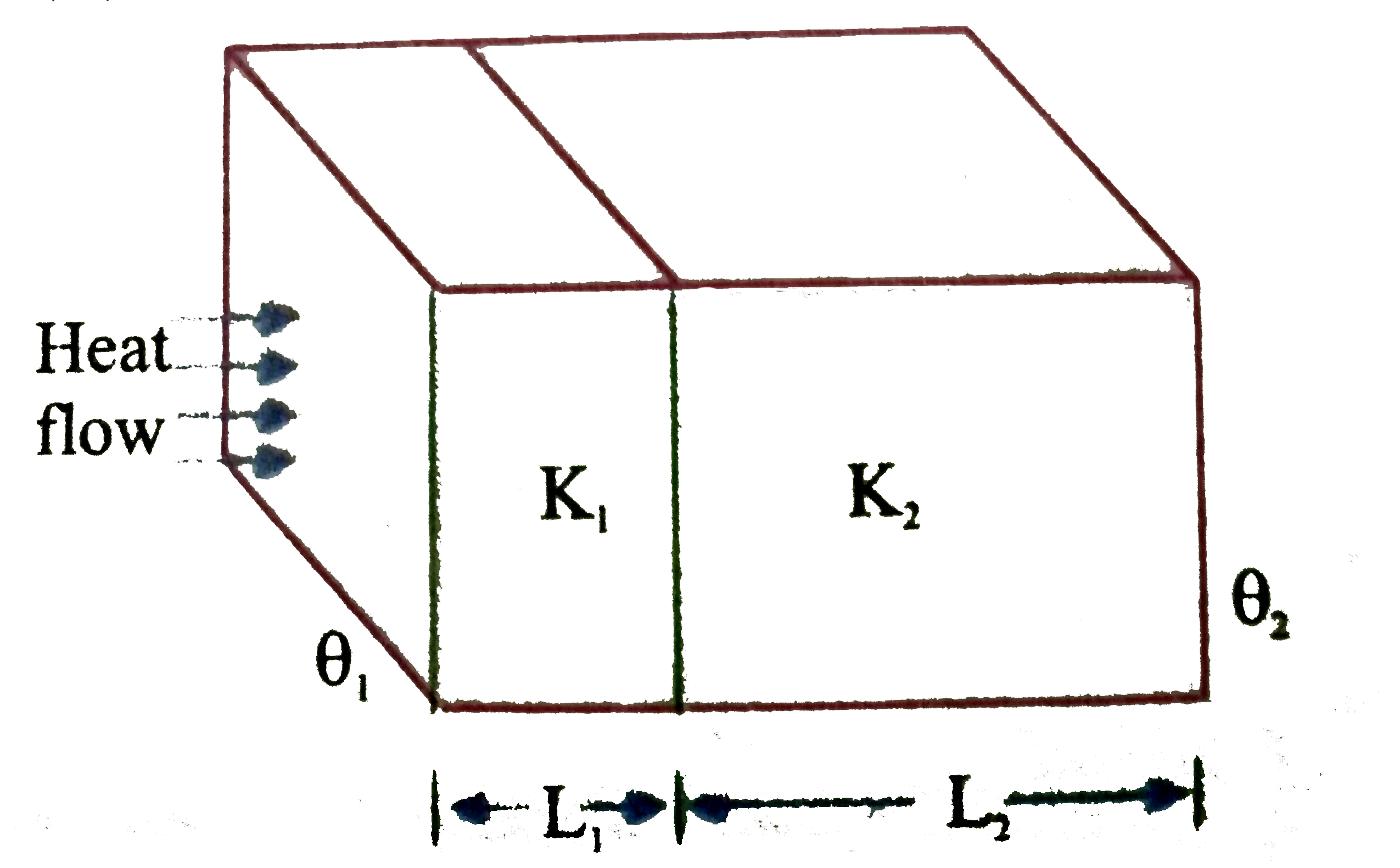
Two plates each of area `A` thickness `L_(1)` and `L_(2)` thermal conductivities `K_(1)` and `K_(2)` respectively are joined to from a single plate of thickness `(L_(1)+L_(2))` If the temperatures of the free surfaces are `theta_(1)` and `theta_(2)` Calculate
(a) Rate of flow of heat
(b) Temperature of interface
.

Promotional Banner

Similar Questions

Explore conceptually related problems

Two plates eachb of area A, thickness L_1 and L_2 thermal conductivities K_1 and K_2 respectively are joined to form a single plate of thickness (L_1+L_2) . If the temperatures of the free surfaces are T_1 and T_2 . Calculate. (a) rate of flow of heat (b) temperature of interface and (c) equivalent thermal conductivity.

Two plates eachb of area A, thickness L_1 and L_2 thermal conductivities K_1 and K_2 respectively are joined to form a single plate of thickness (L_1+L_2) . If the temperatures of the free surfaces are T_1 and T_2 . Calculate. (a) rate of flow of heat (b) temperature of interface and (c) equivalent thermal conductivity.

Two materials having coefficients of thermal conductivity '3k' and 'k' and thickness 'd' and '3d' respectively, are joined to form a slab as shown in the figures. The temperatures of the outer surfaces are theta_(2) and theta_(1) respectively (theta_(2) gt theta_(2)) . The temperature at the interface is :

Two walls of thicknes l_(1) and l_(2) and ther-mal condctivities K_(1) and K_(2) are in contact In the steady state, if the temperature at the outer faces are T_(1) and T_(2) find the temperature at the common wall .

Two materials having coefficients of thermal conductivity ‘3 K’ and ‘K’ and thickness ‘d’ and ‘3 d’, respectively, are joined to form a slab as shown in the figure. The temperatures of the outer surfaces are theta_(2) and theta_(1) respectively, (theta_(2) gt theta_(1)) The temperature at the interface is:

Two slabs are of the thicknesses d_(1) and d_(2) . Their thermal conductivities are K_(1) and K_(2) respectively They are in series. The free ends of the combination of these two slabs are kept at temperatures theta_(1) and theta_(2) . Assume theta_(1)gttheta_(2) . The temperature theta of their common junction is

If two conducting slabs of thickness d_1 and d_2 , and thermal conductivity K_1 and K_2 are placed together face to face as shown in figure in the steady state temperature of outer surfaces are theta_1 and theta_2 . The temperature of common surface is-

If two metallic plates of equal thickness and thermal conductivities K_(1) and K_(2) are put together face to face and a common plate is constructed, then the equivalent thermal conductivity of this plate will be