

Home
Class 11
PHYSICS
In figure S(1) andS(1) are identical spr...

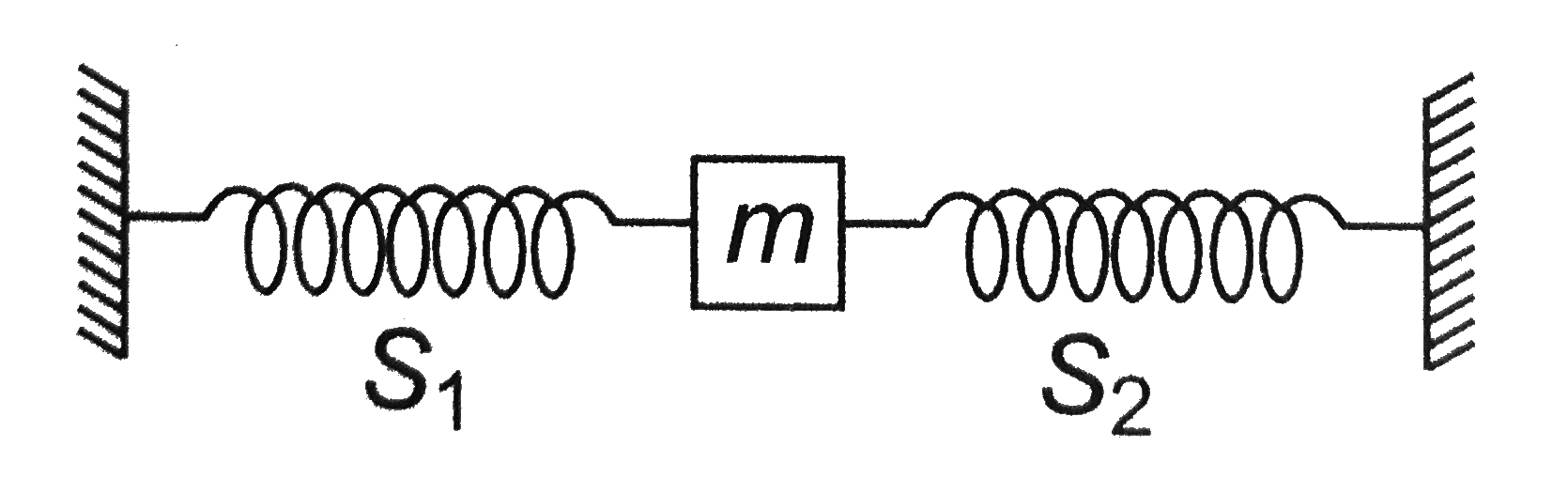
In figure `S_(1)` and`S_(1)` are identical springs. The oscillation frequency of the mass `m` is `f`. if one spring is removed, the frequency will become

Promotional Banner

Similar Questions

Explore conceptually related problems

In the figure, S_1 and S_2 are identical springs. The oscillation frequency of the mass m is f. If one spring is removed, the frequency will become

S_(1) and S_(2) are two identical springs. The oscillation frequency is f. If one springs is removed, frequency will be

Two identical springs S_(1) and S_(2) are joined as shown in the figure. The oscillation frequency of the mass m is v. What will be the frequency of mass m, if one spring is removed ?

When a mass m is connected individually to two springs S_(1) and S_(2) , the oscillation frequencies are v_(1) and v_(2) . If the same mass is attached to the two springs as shown in figure, the oscillation frequency would be

When a mass m is connected individually to two springs S_(1) and S_(2) , the oscillation frequencies are v_(1) and v_(2) . If the same mass is attached to the two springs as shown in figure, the oscillation frequency would be

When a mass m is connected individually to two spring S_(1) and S_(2) , the oscillation frequencies are v_(1) and v_(2) . If the same mass is attached to the two springs as shwon in figure., the oscillation frequecy would be

There are two springs. One delicate and another stiffer. Same mass m is attached to both. For which spring the frequency of oscillation will be more?

A weightless spring has a force constant k oscillates with frequency f when a mass m is suspended from it The spring is cut into three equal parts and a mass 3 m is suspended from it The frequency of oscillation of one part will now become