

Home
Class 12
PHYSICS
A charge particle of mass m and charge q...

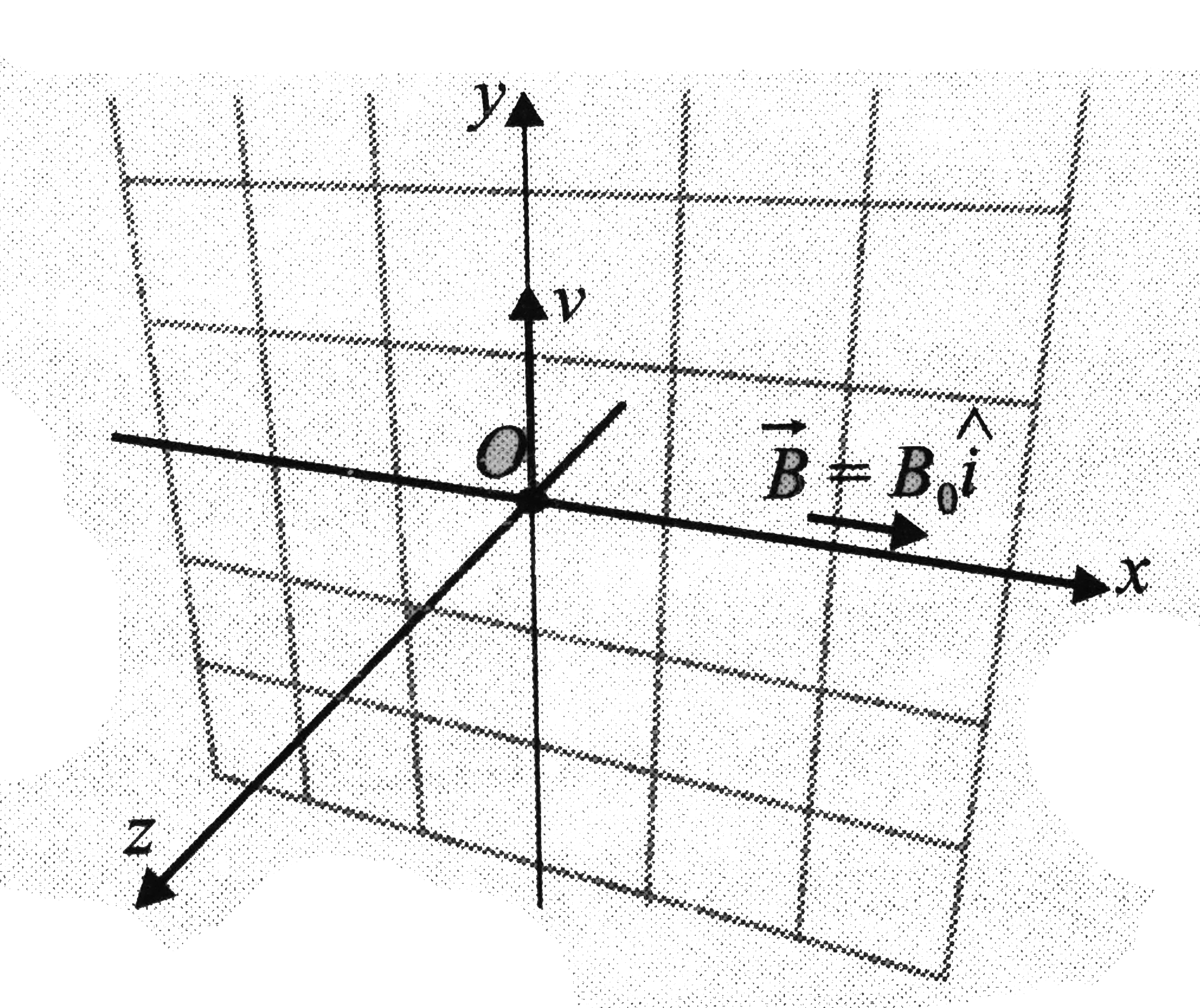
A charge particle of mass m and charge q is projected with velocity v along y-axis at `t=0.`

Find the velocity vector and position vector of the particle `vec v (t) and vec r (t)` in relation with time.

Promotional Banner

Similar Questions

Explore conceptually related problems

A particle of mass m is moving along the line y-b with constant acceleration a. The areal velocity of the position vector of the particle at time t is (u=0)

In a right handed coordinate system XY plane is horizontal and Z-axis is vertically npward. A uniform magnetic field exist in space in vertically npward direction with magnetic induction B. A particle with mass m and charge q is projected from the origin of the coordinate system at t= 0 with a velocity vector given as vec(v) = v_(1) hat(i) + v_(2) hat(k) Find the velocity vector of the particle after time t.

A particle of mass m and charge q is projected into a uniform magnetic field underset(B)to=-B_(0)hatK with velocity underset(V)to-V_(0)hati from origin. The position vector of the particle at time t is underset(r)to . Find the impulse of magnetic force on the particle by the time underset(r)to.underset(V)to becomes zero for the first time.

A particle having mass m and charge q is projected with a velocity v making an angle q with the direction of a uniform magnetic field B. Calculate the magnitude of change in velocity of the particle after time t=(pim)/(2qB) .

If in previous illustration, The charge particle is projected at angle alpha with x-axis with magnitude of velocity. Find a. velocity vector in function of time vec v (t). b. position vector in function of time vec r (t).

If in previous illustration, The charge particle is projected at angle alpha with x-axis with magnitude of velocity. Find a. velocity vector in function of time vec v (t). b. position vector in function of time vec r (t).

A particle of mass m is travelling with a constant velocity v=v_(0)hati along the line y=b,z=0 . Let dA be the area swept out by the position vector from origin to the particle in time dt and L the magnitude of angular momentum of particle about origin at any time t. Then

A particle of mass m is travelling with a constant velocity v=v_(0)hati along the line y=b,z=0 . Let dA be the area swept out by the position vector from origin to the particle in time dt and L the magnitude of angular momentum of particle about origin at any time t. Then