

Home
Class 12
PHYSICS
A thin, 50 cm long metal bar with mass 7...

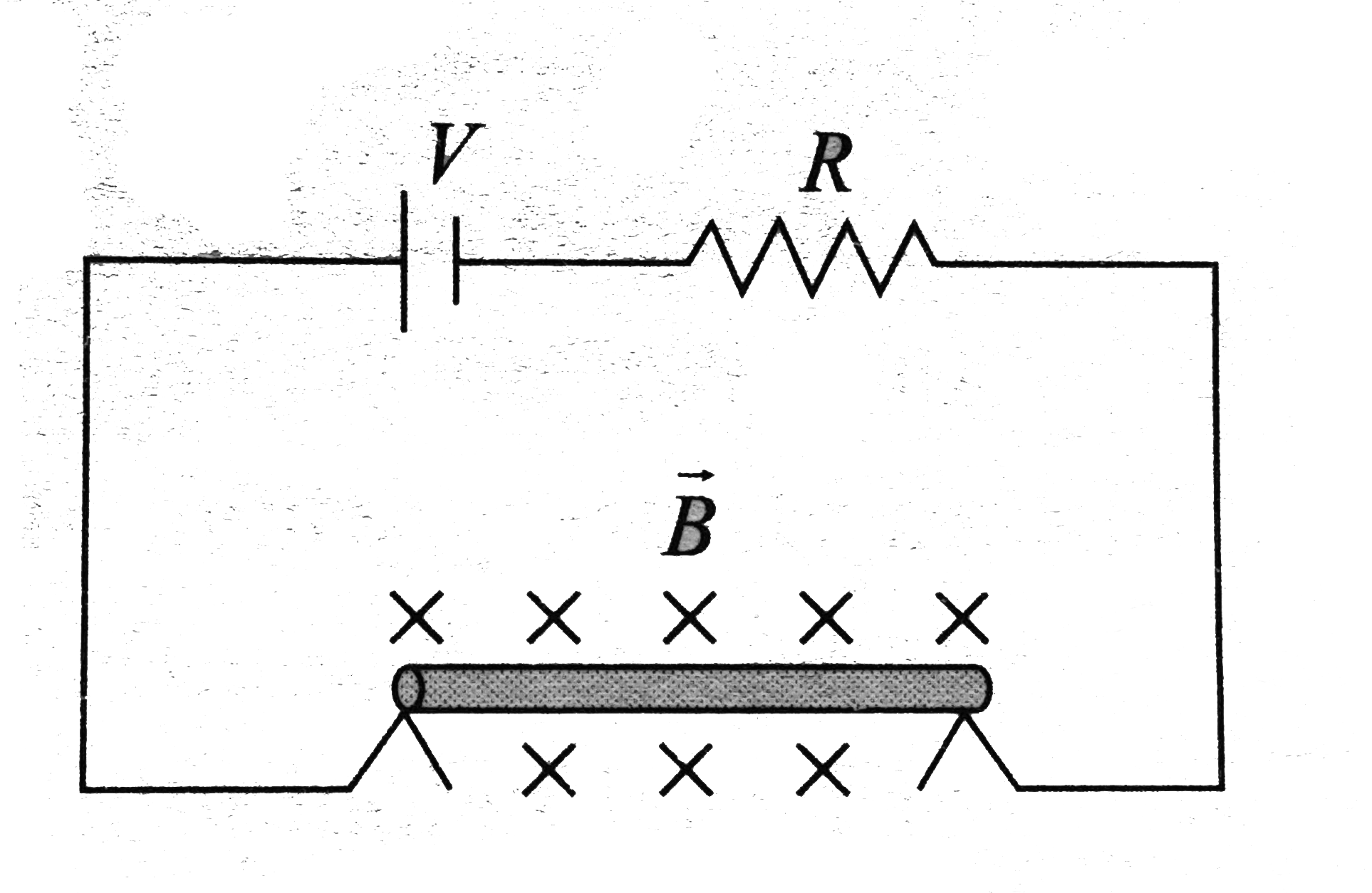
A thin, 50 cm long metal bar with mass 750 g rests on, but is not attrached to, two metallic supports in a uniform 0.450T magnetic field, as shown in fig. A battery and a `25Omega` resistor in series are connected to the supports.

What is the largest voltage the battery can have without breaking the circuit at the supports?

Promotional Banner

Similar Questions

Explore conceptually related problems

A thin, 50.0 cm long metal bar with mass 750 g rests on, but is not attached to, two metal supports in a 0.950 T magnetic field as shown in figure. A battery and a resistance R = 25.0Omega in series are connected to the supports. (a) What is the largest voltage the battery can have without breaking the circuit at the supper (b) The battery voltage has this maximum value calculated. Decreasing the resistance to 2.0 Omega the initial acceleration of the bar.

A thin, 50.0 cm long metal bar with mass 750 g rests on, but is not attached to, two metal supports in a 0.950 T magnetic field as shown in figure. A battery and a resistance R = 25.0Omega in series are connected to the supports. (a) What is the largest voltage the battery can have without breaking the circuit at the supper (b) The battery voltage has this maximum value calculated. Decreasing the resistance to 2.0 Omega the initial acceleration of the bar.

A thin, 50 cm long metal bar with mass 750 g rests on, but is not attrached to, two metallic supports in a uniform 0.450T magnetic field, as shown in fig. A battery and a 25Omega resistor in series are connected to the supports. The battery voltage has the maximum value calculated in above question. If the resistor suddenly gets partially short-circuited, decreasing its resistance to 2 Omega , find the initial accleration of the bat.

A thin, 50 cm long metal bar with mass 750 g rests on, but is not attrached to, two metallic supports in a uniform 0.450T magnetic field, as shown in fig. A battery and a 25Omega resistor in series are connected to the supports. The battery voltage has the maximum value calculated in above question. If the resistor suddenly gets partially short-circuited, decreasing its resistance to 2 Omega , find the initial accleration of the bat.

In the circuit shown in fig. 7.24 , all the resistors are rated at a maximum power of 1.00 W . What is the maximum emf epsilon that the battery can have without burning up any of the resistors?

In the circuit shown in fig. 7.24 , all the resistors are rated at a maximum power of 1.00 W . What is the maximum emf epsilon that the battery can have without burning up any of the resistors?

A pair of parallel conducting rails lie at right angle to a uniform magnetic field of 2.0T as shown in the fig. two resistor 10Omega and 5Omega are to slide without friction along the rail. The distance between the conducting rails is 0.1m . Then

A pair of parallel conducting rails lie at right angle to a uniform magnetic field of 2.0T as shown in the fig. two resistor 10Omega and 5Omega are to slide without friction along the rail. The distance between the conducting rails is 0.1m . Then

A metallic ring of radius r with a uniform metallic spoke of negligible mass and length r is rotated about its axis with angular velocity omega in a perpendicular uniform magnetic field B as shown in Fig. 3.163. The central end of the spoke is connected to the rim of the wheel through a resistor R as shown. The resistor does not rotate, its one end is always at the center of the ring and the other end is always in as shown is needed to maintain constant angular velocity of the wheel. F is equal to (the ring and the spoke has zero resistance)